
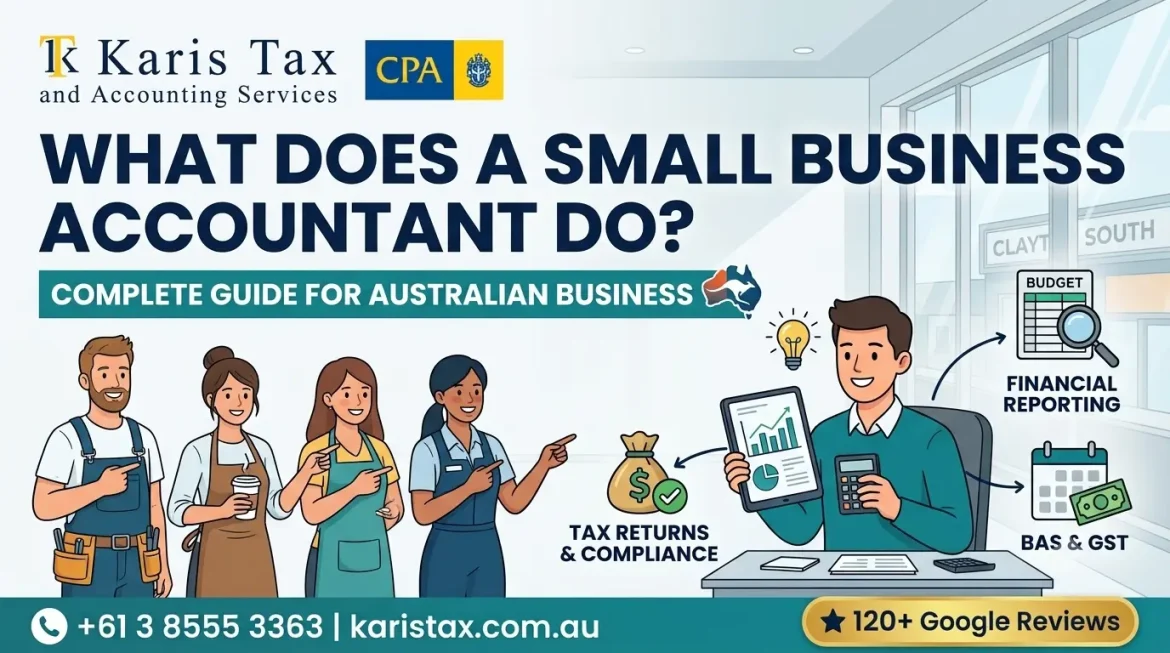
What Does a Small Business Accountant Do? Complete Guide for Australian Businesses
A small business accountant helps business owners manage financial records, tax obligations, reporting and accounting requirements. Depending on the business structure and circumstances, an accountant may assist with business tax returns, bookkeeping, BAS, GST, payroll, financial reporting, tax planning and ATO compliance.
The services an accountant can provide depend on their qualifications, registration and the specific requirements of the business.
For example, tax agent services provided for a fee generally require registration with the Tax Practitioners Board (TPB) unless an exemption applies. BAS services provided for a fee or other reward also generally require appropriate TPB registration.
At Karis Tax, we provide small business accounting and tax support for businesses in Clayton South and surrounding Melbourne areas.
What Does a Small Business Accountant Actually Do?
The role of a small business accountant can vary depending on the size, structure and needs of the business.
Common accounting services may include:
- Business tax return preparation and lodgement
- Bookkeeping and financial record management
- BAS preparation and lodgement
- GST reporting and support
- Payroll support
- Financial reporting
- Tax planning
- Business structure considerations
- ATO compliance support
- Business expense and deduction guidance
Where a service is a regulated tax or BAS service, it should be provided by an appropriately registered tax agent or BAS agent, where required. A business may use an accountant for one specific service, such as an annual tax return, or for ongoing accounting and financial support.
1. Business Tax Returns
One of the main services a small business accountant may provide is assistance with income tax obligations.
Tax return requirements differ depending on the business structure. Sole traders generally report their business income and relevant business information through their individual income tax return rather than lodging a separate business tax return. Companies, trusts and other structures can have different reporting requirements.
An appropriately registered tax agent can assist with:
- Reviewing business income
- Reviewing business expenses
- Identifying relevant deductions
- Preparing financial information
- Preparing the tax return
- Reviewing the completed return
- Lodging the return with the ATO
- Providing tax-related advice
Karis Tax and Accounting page states that it provides tax return preparation and lodgement and taxation consulting and advice as a registered tax agent.
2. Bookkeeping and Financial Records
Bookkeeping involves recording and organising the financial transactions of a business.
This can include:
- Recording sales
- Recording business expenses
- Bank reconciliation
- Managing invoices
- Tracking payments
- Maintaining financial records
- Preparing financial information for tax and BAS reporting
Good record keeping can help business owners understand their financial position, manage cash flow and meet applicable tax and reporting obligations.
Karis Tax provides bookkeeping services for small and medium businesses, including bookkeeping support, GST-related work and BAS preparation and lodgement.
3. BAS Preparation and Lodgement
A Business Activity Statement (BAS) is used by businesses to report and pay certain tax obligations, including GST and some PAYG obligations.
BAS services can include activities such as:
- BAS preparation
- BAS review
- GST reporting
- PAYG reporting
- Reconciling financial records
- BAS lodgement
- Assistance with overdue BAS matters
However, BAS services are regulated. An entity providing BAS services for a fee or other reward generally needs to be registered with the Tax Practitioners Board, unless an applicable exemption applies.
The TPB explains that BAS services can involve advising on or determining a client’s liabilities, obligations or entitlements under BAS provisions, including GST and PAYG matters.
4. GST Management
GST can be an important consideration for many Australian businesses.
Depending on the business’s circumstances, accounting support may include:
- GST registration guidance
- GST record keeping
- GST reconciliation
- GST reporting
- BAS preparation
- GST compliance support
Not every business has the same GST obligations. The appropriate treatment depends on the business’s circumstances and current ATO requirements.
Where GST advice or BAS services constitute regulated services, they should be provided by an appropriately registered tax agent or BAS agent, where required. The TPB identifies GST-related services as part of the BAS framework in relevant circumstances.
5. Payroll and Employee Accounting
If a small business employs staff, payroll becomes an important part of financial administration.
Depending on their qualifications, role and registration, an accountant or payroll professional may assist with areas such as:
- Payroll processing
- PAYG withholding administration
- Employee records
- Payslips
- Superannuation-related records
- Payroll reporting
- Single Touch Payroll (STP)
However, not every accountant or payroll professional is authorised or qualified to provide every payroll, tax or BAS-related service.
Where payroll work involves regulated tax or BAS services, the service should be provided by an appropriately registered tax agent or BAS agent, where required.
Karis Tax currently offers payroll services as part of its bookkeeping services.
6. Financial Reporting
A small business accountant can help business owners understand how their business is performing through financial reports.
Depending on the business, reports may include:
Profit and Loss Statement
Shows business income, expenses and the resulting profit or loss for a particular period.
Balance Sheet
Provides information about the business’s assets, liabilities and equity.
Cash Flow Information
Helps business owners understand money coming into and going out of the business.
Financial reports can help business owners make informed decisions about expenses, growth and cash flow.
7. Tax Planning
Tax planning involves considering a business’s tax position and obligations based on its circumstances and applicable Australian tax rules.
An appropriately qualified and registered tax professional may assist with areas such as:
- Tax planning
- Business deductions
- Taxable income
- PAYG instalments
- GST considerations
- Capital Gains Tax considerations
- Year-end tax preparation
The objective is not simply to reduce tax at any cost. Appropriate tax planning should consider the applicable Australian tax rules and the specific circumstances of the business.
8. Business Structure
The structure of a business can affect its tax and reporting obligations.
Common business structures include:
- Sole trader
- Partnership
- Company
- Trust
The tax treatment and reporting requirements can differ between structures.
An accountant can help business owners understand the accounting and tax considerations associated with their business structure. Where a matter involves legal advice or complex legal structuring, specialist legal advice may also be appropriate.
For example, a sole trader generally reports business income and relevant business information through their individual tax return.
9. ATO Compliance
Australian businesses can have different tax and reporting obligations depending on their structure, registrations and activities.
These may include:
- Income tax
- GST
- BAS
- PAYG
- Payroll-related obligations
- Record keeping
- Other applicable tax reporting
An appropriately qualified and registered tax professional can help businesses understand applicable obligations, prepare relevant information and meet reporting requirements.
If you have outstanding tax or BAS obligations, professional assistance can also help you understand the appropriate next steps.
What Is the Tax Practitioners Board?
The Tax Practitioners Board (TPB) regulates registered tax and BAS practitioners in Australia.
People or entities providing tax agent services or BAS services for a fee or other reward generally need to be registered with the TPB unless an applicable exemption applies.
The TPB maintains a public register where consumers can check whether a tax or BAS practitioner is registered.
Important: Registration requirements depend on the nature of the service and the circumstances. Businesses should check the current TPB requirements where necessary.
Do I Need a Small Business Accountant?
You are not necessarily required to hire an accountant for every aspect of running a business.
However, professional accounting support can be useful when:
- You’re starting a new business
- Your business is growing
- Your bookkeeping is becoming difficult to manage
- You need help with BAS or GST
- You’re hiring employees
- Your tax affairs are becoming more complex
- You have overdue tax obligations
- You need financial reports
- You’re considering changing your business structure
- You want professional tax planning advice
The type of professional you need depends on the services required and their qualifications or registration.
How Can a Small Business Accountant Help a New Business?
A new business may need to establish systems for:
- Business banking
- Bookkeeping
- Record keeping
- Tax registrations
- GST
- BAS
- Payroll
- Financial reporting
- Tax planning
Setting up these processes correctly from the beginning can make financial management easier as the business grows. Where tax or BAS services are involved, make sure the practitioner is appropriately registered where required.
When Should I Hire a Small Business Accountant?
There isn’t one specific point when every business should hire an accountant.
You may want professional accounting support when your business:
Starts → grows → hires employees → registers for GST → has more complex tax obligations → needs financial reporting → requires ongoing tax planning.
You can also engage an accountant earlier if you want professional guidance when establishing your financial systems.
How Much Does a Small Business Accountant Cost?
There is no single price for small business accounting services.
The cost can depend on:
- Business size
- Number of transactions
- Services required
- Bookkeeping workload
- Payroll requirements
- BAS frequency
- Tax complexity
- Whether you need one-off or ongoing support
For this reason, accounting firms may provide different pricing depending on the services required.
Small Business Accountant in Clayton South & Melbourne
Karis Tax provides small business accounting services in Clayton South and surrounding Melbourne suburbs.
Services may include:
- Business tax returns
- Bookkeeping
- BAS
- GST
- Payroll
- Financial reporting
- Tax planning
- ATO compliance
Whether you’re a new business owner or an established small business, the appropriate accounting and tax support can help you manage your financial and compliance requirements.
Karis Tax’s existing small business service page covers bookkeeping, BAS/GST/IAS, payroll, financial reporting, business and personal tax returns, tax advice and business structure considerations.
Frequently Asked Questions
What does a small business accountant do?
A small business accountant may assist with business tax returns, bookkeeping, BAS, GST, payroll, financial reporting, tax planning and compliance requirements, depending on their qualifications, registration and the services they provide.
Do I need a small business accountant?
Not every business needs ongoing accounting services. Professional support can be useful when dealing with tax, BAS, bookkeeping, payroll, financial reporting or more complex business requirements.
What is the difference between an accountant and a bookkeeper?
A bookkeeper generally focuses on recording and organising day-to-day financial transactions. An accountant may provide broader services such as financial analysis, tax preparation, financial reporting and tax-related advice, subject to their qualifications and registration.
Can a small business accountant help with BAS?
Yes, where the practitioner is appropriately registered to provide the relevant BAS service. BAS services provided for a fee or other reward generally require TPB registration unless an exemption applies.
Can an accountant help with tax planning?
Yes. An appropriately qualified and registered tax professional can provide tax-related planning and advice based on the business’s circumstances and applicable Australian tax rules.
When should I hire an accountant?
You may consider hiring an accountant when starting or growing a business, hiring employees, dealing with GST or BAS, managing complex tax obligations, needing financial reporting or requiring ongoing tax planning.
Does a sole trader lodge a separate business tax return?
Generally, no. A sole trader reports business income and relevant business information through their individual income tax return. The requirements can differ depending on the taxpayer’s circumstances.
Conclusion
A small business accountant can do much more than prepare an annual tax return. Depending on the business and the professional’s qualifications and registration, accounting support may include tax returns, bookkeeping, BAS, GST, payroll, financial reporting, tax planning and compliance.
For small business owners, organised financial records and a clear understanding of tax obligations can make it easier to manage finances and make informed business decisions.
If you need professional accounting support, Karis Tax provides small business accounting services in Clayton South and Melbourne.

Choosing the Best Bookkeeping Packages for Small Businesses in Clayton
In today’s fast-paced business world, effective bookkeeping is essential for the success of any small business. Properly managing your finances not only ensures compliance with tax laws but also provides valuable insights into your company’s financial health.
Bookkeeping packages are software solutions that help small businesses manage their financial transactions, invoices, expenses, and more. These packages are designed to simplify the bookkeeping process, allowing business owners to focus on running their businesses rather than spending hours on paperwork.
One of the most efficient ways to manage your finances is by using bookkeeping packages specifically designed for small businesses. In this article, we’ll explore what bookkeeping packages are, why they’re important, and how to choose the right one for your business.
Types of Bookkeeping Packages
There are several types of bookkeeping packages available, each offering different features and functionalities to suit the needs of different businesses.
- Basic Bookkeeping Packages: These packages typically include essential features such as invoicing, expense tracking, and basic financial reporting.
- Advanced Bookkeeping Packages: Advanced packages offer additional features such as inventory management, project tracking, and payroll processing.
- Customized Bookkeeping Packages: Some software providers offer the option to customize bookkeeping packages based on the specific needs of your business.
Features of Bookkeeping Packages
Bookkeeping packages offer a wide range of features to help small businesses manage their finances effectively. Some of the most common features include:
- Invoicing and Billing: Create and send professional invoices to clients and track payments.
- Expense Tracking: Easily track business expenses and categorize them for tax purposes.
- Bank Reconciliation: Automatically reconcile bank transactions with your accounting records to ensure accuracy.
- Financial Reporting: Generate customizable financial reports such as profit and loss statements, balance sheets, and cash flow statements.
Cost of Bookkeeping Packages
The cost of bookkeeping packages can vary depending on the provider and the features included. Most bookkeeping packages operate on a monthly subscription basis, with prices ranging from a few dollars to several hundred dollars per month. In addition to the monthly subscription fee, some providers may charge extra for additional services such as payroll processing or tax filing.
Factors to Consider When Choosing a Bookkeeping Package
When choosing a bookkeeping package for your small business, there are several factors to consider:
- Business Size: Consider the size and complexity of your business and choose a package that can accommodate your needs.
- Budget: Determine how much you’re willing to spend on bookkeeping software and choose a package that fits your budget.
- The complexity of Financial Transactions: Consider the complexity of your financial transactions and choose a package that offers the features you need.
Top Bookkeeping Packages for Small Businesses
There are many bookkeeping packages available on the market, but some of the top options for small businesses include:
- QuickBooks Online: One of the most popular bookkeeping packages, QuickBooks Online offers a wide range of features and integrations to help small businesses manage their finances.
- Xero: Xero is another popular choice for small businesses, offering features such as invoicing, expense tracking, and bank reconciliation.
- FreshBooks: FreshBooks is known for its user-friendly interface and robust features, including time tracking, project management, and invoicing.
- Wave Financial: Wave Financial offers a suite of financial management tools for small businesses, including accounting, invoicing, and payroll processing.
- Zoho Books: Zoho Books is a comprehensive bookkeeping solution that offers features such as invoicing, expense tracking, and financial reporting.
Comparison of Bookkeeping Packages
When choosing a bookkeeping package for your small business, it’s important to compare the features and pricing of different options. Here’s a comparison of some of the top bookkeeping packages:
| Feature | QuickBooks Online | Xero | FreshBooks | Wave Financial | Zoho Books |
| Invoicing and Billing | Yes | Yes | Yes | Yes | Yes |
| Expense Tracking | Yes | Yes | Yes | Yes | Yes |
| Bank Reconciliation | Yes | Yes | Yes | Yes | Yes |
| Financial Reporting | Yes | Yes | Yes | Yes | Yes |
| Monthly Cost | $25 – $150/month | $12 – $60/month | $15 – $50/month | Free – $35/month | $9 – $29/month |
How to Choose the Right Bookkeeping Package for Your Business
Choosing the right bookkeeping package for your business can be a daunting task. Here are some tips to help you make the right decision:
- Assess Your Business Needs: Determine which features are most important for your business and choose a package that offers those features.
- Consider Your Budget: Compare the pricing of different packages and choose one that fits your budget.
- Take Advantage of Free Trials: Many bookkeeping packages offer free trials, allowing you to test out the software before committing to a subscription.
Setting Up Your Bookkeeping Package
Once you’ve chosen a bookkeeping package for your small business, the next step is to set it up. Here’s how to get started:
- Inputting Business Information: Enter your business information, including your company name, address, and tax ID number.
- Connecting Bank Accounts: Connect your bank accounts to the bookkeeping software to automatically import transactions.
- Customizing Account Settings: Customize your account settings to fit the needs of your business, such as setting up tax rates and invoice templates.
Training and Support
Most bookkeeping packages offer training and support to help you get started. Here are some resources you can take advantage of:
- Tutorials and Guides: Many bookkeeping packages offer tutorials and guides to help you learn how to use the software.
- Customer Support: If you run into any issues, most bookkeeping packages offer customer support via phone, email, or live chat.
Common Mistakes to Avoid
When using bookkeeping software for your small business, there are some common mistakes to avoid:
- Neglecting to Reconcile Accounts: Make sure to regularly reconcile your bank accounts with your accounting records to ensure accuracy.
- Mixing Personal and Business Finances: Keep your personal and business finances separate to avoid confusion and potential tax issues.
Benefits of Using Bookkeeping Packages
Using a bookkeeping package for your small business offers several benefits:
- Time-Saving: Automate repetitive tasks such as invoicing and expense tracking, saving you time and effort.
- Improved Accuracy: Reduce the risk of human error by automating your bookkeeping processes.
- Better Financial Decision-Making: Gain valuable insights into your company’s financial health and make more informed decisions.
Final Point
Choosing the right bookkeeping package is essential for the success of your small business. By considering your business needs, budget, and the features offered by different packages, you can find the perfect solution to help you manage your finances more effectively.
FAQ
How much does a bookkeeping package cost?
The cost of a bookkeeping package can vary depending on the provider and the features included. Prices typically range from a few dollars to several hundred dollars per month.
What features are included in a bookkeeping package?
Some common features of bookkeeping packages include invoicing and billing, expense tracking, bank reconciliation, and financial reporting.
Can I customize a bookkeeping package to fit my business’s needs?
Yes, many bookkeeping packages offer the option to customize the software based on the specific needs of your business.
How do I choose the right bookkeeping package for my business?
When choosing a bookkeeping package, consider factors such as your business size, budget, and the complexity of your financial transactions.
What are the benefits of using a bookkeeping package for my small business?
Using a bookkeeping package can save you time, improve accuracy, and provide valuable insights into your company’s financial health.

Business Accounting Services: Navigating Financial Success
Embarking on the journey of financial prosperity requires more than just managing numbers—it demands a strategic alliance with experts who understand the intricate nuances of business accounting.
In this exploration, we delve into the world of business accounting services, with a spotlight on Karis Tax’s distinguished offerings. As businesses navigate the complex terrain of financial management, the importance of accurate records, compliance, and strategic insights cannot be overstated. Join us in unravelling the integral role played by Karis Tax in shaping financial success, where each number tells a story of growth and resilience.
Karis Tax Business Accounting Services In Clayton South, Australia

Business accounting services, including those offered by Karis Tax, encompass a suite of financial activities provided by professionals to manage and optimize financial processes for businesses and individuals.
These services, tailored by Karis Tax, include bookkeeping, financial statement preparation, tax planning and preparation, audit and assurance services, and management consulting.
Businesses partnering with Karis Tax benefit from accurate financial records, compliance with tax regulations, and strategic financial insights, ultimately contributing to effective decision-making and business growth. The expertise and reliability of Karis Tax make them a trusted partner in navigating the complex landscape of business accounting.
What Are The Categories Of Accounting Services?

Accounting services encompass a broad spectrum of financial activities crucial for businesses and individuals alike. These services can be categorized into five main areas, each serving a specific purpose in managing and optimizing financial processes:
Bookkeeping Services: Foundational to all accounting activities, bookkeeping involves recording daily transactions, maintaining ledgers, and ensuring accuracy in financial records.
Financial Statement Preparation: Accountants prepare comprehensive financial statements, including income statements, balance sheets, and cash flow statements. These documents provide a snapshot of a company’s financial health.
Tax Planning and Preparation: Accounting services extend to strategic tax planning to minimize liabilities. Accountants also play a vital role in preparing and filing accurate tax returns, ensuring compliance with tax regulations.
Audit and Assurance Services: Businesses often engage accounting firms for audits to assess the accuracy and reliability of financial information. Assurance services provide stakeholders with confidence in the integrity of financial reporting.
Management Consulting: Beyond traditional accounting functions, accountants offer management consulting services. This involves providing insights and recommendations to enhance financial efficiency, budgeting, and overall business performance.
What Are The Major Types Of Accounting Systems?

Accounting systems are crucial for organizing financial data and facilitating effective decision-making. Two significant types of accounting systems dominate the economic landscape: Cash-based accounting and accrual-based accounting.
-
Cash Basis Accounting:
In this straightforward system, transactions are recorded only when cash changes hands. Revenues and expenses are recognized at the moment of cash inflow or outflow. It provides a clear view of the actual cash position but may not accurately represent long-term financial health, as it doesn’t consider future obligations or income.
-
Accrual Basis Accounting:
Contrastingly, accrual accounting recognizes transactions when they occur, irrespective of when cash is exchanged. This method provides a more comprehensive understanding of a business’s financial health, factoring in future obligations and income. Accrual accounting aligns better with Generally Accepted Accounting Principles (GAAP) and is favoured for its ability to provide a more accurate long-term financial picture.
Choosing between these systems depends on the nature and size of the business. Small enterprises often lean towards cash-based accounting for simplicity, while larger entities tend to adopt accrual accounting for its comprehensive and compliant financial reporting capabilities. The choice between these accounting systems significantly impacts how businesses measure profitability, track financial performance, and make strategic decisions.
What Are The Different Types of Accounting Services

The Essentials of Business Accounting:
At its core, business accounting involves recording, analyzing, and interpreting financial transactions. Whether a small startup or a large enterprise, understanding basic accounting principles is fundamental to effective financial management.
Types of Business Accounting Services:
Businesses can access a range of accounting services, from day-to-day bookkeeping to complex financial analysis. Services include bookkeeping, financial reporting, tax preparation, and advisory services tailored to the unique needs of each business.
Benefits of Professional Business Accounting:
Outsourcing accounting services offers numerous advantages. Businesses can save time, reduce costs, ensure accuracy, and stay compliant with ever-changing financial regulations. Professional accountants bring expertise that goes beyond number-crunching.
Choosing the Right Business Accounting Service Provider:
Selecting the right accounting service provider is crucial. Businesses should consider factors such as industry-specific knowledge, reliability, and the ability to scale services based on business growth.
Tailored Solutions for Small Businesses:
Small businesses often have unique accounting needs. Professional services can be tailored to provide cost-effective solutions, allowing small enterprises to focus on growth without compromising financial accuracy.
Navigating Tax Compliance:
Business accounting services play a pivotal role in meeting tax obligations. From accurate record-keeping to tax planning, professionals ensure businesses comply with tax laws, minimizing the risk of penalties.
The Role of Technology in Business Accounting:
Advancements in technology have transformed accounting practices. Software, automation, and cloud-based solutions streamline processes, enhancing efficiency and providing real-time insights into financial data.
Addressing Financial Challenges:
Professional accounting services assist businesses in overcoming financial challenges. From budgeting to financial planning, accountants provide strategic guidance to navigate complex economic landscapes.
Industry-Specific Accounting Services:
Different industries have unique accounting requirements. Professionals with industry-specific knowledge can tailor services to meet the nuanced financial needs of businesses in sectors such as retail, healthcare, or manufacturing.
Ensuring Data Security and Confidentiality:
The secure handling of financial data is paramount. Business accounting service providers implement robust measures to ensure data security and confidentiality, safeguarding sensitive information.
Evaluating Return on Investment (ROI):
Investing in professional accounting services contributes to overall ROI. Accurate financial records, strategic financial planning, and compliance efforts positively impact the economic health and growth of a business.
Cost Considerations for Business Accounting Services:
Understanding the costs associated with professional accounting services is essential. Different pricing models exist, and businesses should evaluate potential fees against the value and expertise provided.
Real-world Success Stories:
Examining real-world success stories showcases the tangible benefits of professional accounting services. Anonymized examples illustrate how businesses have thrived with the support of knowledgeable accountants.
Common Misconceptions About Business Accounting:
Debunking myths surrounding accounting services fosters a more precise understanding. Addressing common misconceptions ensures businesses make informed decisions about their financial management.
Future Trends in Business Accounting:
The accounting landscape is evolving. Examining future trends sheds light on how technology and changing business dynamics will influence accounting practices in the years to come.
Client Testimonials:
Client testimonials provide authentic perspectives on the impact of professional accounting services. Hearing from businesses that have experienced success instils confidence in potential clients.
Challenges in Business Accounting:
Acknowledging potential challenges in business accounting allows for proactive solutions. Highlighting common pitfalls and offering strategies to mitigate risks ensures businesses are prepared.
The Bottom Line
In the realm of business, the significance of professional accounting services, exemplified by firms like Karis Tax, cannot be overstated. From meticulous bookkeeping to strategic tax planning, these services form the bedrock of financial health. Karis Tax’s expertise ensures accurate records, compliance, and invaluable insights. As businesses navigate the complexities of economic landscapes, partnering with Karis Tax becomes synonymous with achieving enduring prosperity. The tailored approach, industry-specific knowledge, and commitment to excellence make business accounting services not merely a necessity but a catalyst for sustained growth and success.
FAQs (Frequently Asked Questions)
Why is professional accounting essential for businesses of all sizes?
Professional accounting ensures accurate financial records, compliance with regulations, and strategic financial planning, contributing to overall business success.
How do businesses benefit from outsourcing accounting services?
Outsourcing accounting services saves time, reduces costs, and provides access to expertise, allowing businesses to focus on core operations.
What factors should businesses consider when choosing an accounting service provider?
Consider industry-specific knowledge, reliability, scalability, and a provider’s track record when selecting an accounting service.
How do accounting services help small businesses specifically?
Professional accounting services can be tailored to the unique needs of small businesses, offering cost-effective solutions for financial management.
What is the future of business accounting, considering technological advancements?
The future of business accounting involves increased reliance on technology, automation, and innovative solutions to streamline financial processes.
How Much Does an Accountant Cost Australia? Calculate Navigating Pricing
Accountants are the unsung heroes of financial stability, offering invaluable expertise in navigating the complexities of business finances. As businesses in Australia seek to optimize their financial management, a pertinent question arises: How much does an accountant cost Australia? In this comprehensive guide, we’ll delve into the various factors influencing accountant costs, explore different pricing structures, and provide practical insights into managing accounting expenses for businesses of all sizes. So, please keep reading. Let’s start.
How Much Does an Accountant Cost Australia?
Determining the exact cost of an accountant in Australia can vary based on factors such as qualifications, experience, and the specific services required. Generally, accountants in Australia may charge hourly rates or fixed fees for their services.
The average hourly rate for an accountant can range from $100 to $300, while fixed fees for essential services might start at $500 and can go upwards depending on the complexity of the work.
Industry specialization, geographical location, and the size of the accounting firm can also influence costs. One reputable option is “Karis Tax,” a company known for its personalized and expert financial services. Considering your unique needs, it is advisable to consult with Karis Tax directly to get accurate quotes and understand the full scope of services included in the cost.
Tax Accountant Fees Australia
In Australia, tax accountant fees vary based on factors like the complexity of financial affairs and the services required. Generally, tax accountants may charge hourly rates ranging from $100 to $300, while fixed fees for essential tax services could start at $500. However, these figures can fluctuate depending on location, the accountant’s expertise, and the size of the accounting firm. “Karis Tax” is a reputable company offering Australia’s transparent and personalized tax accountant services. Consider consulting directly with Karis Tax to align your needs with their expertise for accurate pricing and a breakdown of services.
Karis Tax: Tax Accountant Fees in Australia
| Service | Average Cost Range |
| Hourly Rates | $100 – $300 per hour |
| Fixed Fees (Basic Tax) | Starting at $500 |
| Location Influence | Varies based on region |
| Accountant’s Expertise | May impact overall cost |
| Firm Size | Larger firms may charge more |
Types of Accountants
Choosing the right type of accountant is crucial for effective financial management. Public accountants employed by accounting firms offer diverse services to individuals and businesses. Management or corporate accountants focus on internal financial processes for organizational decision-making.
Government accountants handle financial records for public entities, ensuring compliance. Forensic accountants specialize in investigating financial discrepancies and fraud. Auditors examine financial records for accuracy and compliance.
Tax accountants navigate complex tax laws, aiding individuals and businesses in compliance and optimization. Cost accountants analyze production costs, helping companies make cost-effective decisions. Each type plays a vital role in the financial landscape, addressing the specific needs of diverse entities.
Public Accountants
Public accountants work for public accounting firms and offer services to individuals, businesses, and government entities, including tax preparation, auditing, and consulting.
Management Accountants
Also known as cost, corporate, or private accountants, management accountants focus on internal financial processes. They analyze financial data to help organizations make informed business decisions and improve operational efficiency.
Government Accountants
Government accountants work in the public sector, managing financial records for government agencies. They ensure compliance with regulations, handle budgeting, and perform audits to maintain transparency in public finances.
Forensic Accountants
Forensic accountants specialize in investigating financial discrepancies and fraud. They use accounting principles to analyze financial data for legal purposes, often working closely with law enforcement agencies and legal professionals.
Auditors
Auditors examine financial records to ensure accuracy and compliance with relevant regulations. They can work as internal auditors in various sectors, including public accounting firms, government agencies, or within a company.
Tax Accountants
Tax accountants specialize in tax-related matters, helping individuals and businesses comply with tax laws. They prepare tax returns, advise on taxes, and help clients optimize their positions.
Cost Accountants
Cost accountants focus on determining the cost of producing goods and services within a company. They analyze expenses, monitor budgeting, and provide insights to help businesses make cost-effective decisions.
How Much Does an Accountant Cost Australia? Here are the Steps to Better Understand
Factors Influencing Accountant Costs
Understanding the intricacies of accountant costs begins with recognizing the factors that influence these expenses. Qualifications, experience, geographical location, industry specialization, and specific accounting services needed all contribute to the overall pricing equation.
Hourly Rates vs. Fixed Fees
The method of pricing can significantly impact the overall cost of accounting services. We’ll explore the pros and cons of hourly rates versus fixed fees, shedding light on the considerations businesses should weigh when choosing the most suitable pricing structure.
Average Cost Ranges for Accountant Services
Breaking down the costs for essential accounting services and understanding additional fees for specialized tasks clarify what businesses can expect to pay. We’ll outline average cost ranges, providing a benchmark for companies to assess the reasonableness of the quotes they receive.
Comparing Accountant Costs Across Cities
Australia’s vast landscape comes with regional variations in living costs, impacting accountant fees. We’ll explore the differences in accounting costs across significant cities, uncovering the factors contributing to these regional price disparities.
Industry-Specific Considerations
Industries have unique accounting needs, and tailoring services to these needs can influence costs. Our discussion will highlight the impact of industry specialization on accounting fees and offer guidance on navigating industry-specific accounting requirements.
Choosing the Right Accountant for Your Needs
Selecting the right accountant involves a careful evaluation of various factors. We’ll explore the considerations in the selection process, emphasizing the importance of balancing cost with expertise to ensure businesses receive optimal value for their investment.
Negotiating and Understanding Fees
Negotiation skills can play a crucial role in securing fair accounting fees. We’ll provide practical tips for negotiating with accountants and emphasize the importance of transparent fee structures for both parties.
Accounting Software and Cost Savings
Leveraging technology can contribute to cost efficiency in accounting. We’ll discuss popular accounting software options and how businesses can utilize these tools to streamline processes and potentially reduce overall costs.
Government Support and Tax Incentives
Australia offers various subsidies and incentives to businesses. We’ll explore how these government programs can impact accounting costs and highlight the importance of staying informed about available support.
Hiring In-House vs. Outsourcing
The decision to hire an in-house accountant or outsource accounting services has financial implications. We’ll weigh the pros and cons of each approach, providing insights into when outsourcing may be a more cost-effective solution.
Accounting for Small Businesses vs. Large Enterprises
The scale of a business influences its accounting needs and costs. We’ll address the considerations for small businesses versus large enterprises, helping companies tailor their accounting services to align with their size and complexity.
Accountant Costs for Tax Preparation
Tax-related services are a significant component of accounting costs. We’ll break down the costs associated with tax preparation, emphasizing the importance of early tax planning for cost optimization.
Hidden Costs and Considerations
Unanticipated fees can contribute to accounting expenses. We’ll uncover potential hidden costs and guide how businesses can avoid unexpected financial surprises by ensuring transparency in their accounting agreements.
Customer Testimonials and Reviews
Client testimonials and reviews offer valuable insights into the reliability and effectiveness of accounting services. We’ll explore the significance of customer feedback and recommend online resources for businesses to research and assess potential accountants.
Case Studies: Real-world Examples
Real-world examples of businesses effectively managing their accounting costs provide practical insights. We’ll present case studies showcasing successful strategies for cost management, offering valuable lessons for companies seeking to optimize their financial management.
Should Small Business Owners Hire an Accountant
In the dynamic landscape of entrepreneurship, whether small business owners should hire an accountant is a critical consideration. While some entrepreneurs may attempt to manage their finances independently to cut costs, the benefits of hiring a professional accountant are substantial.
An experienced accountant brings expertise in navigating complex tax regulations, ensuring compliance, and potentially identifying valuable deductions that may be overlooked. Moreover, accountants provide strategic financial advice, aiding in budgeting, forecasting, and long-term planning, which is invaluable for small businesses aiming for sustained growth.
By outsourcing the financial responsibilities to a qualified accountant, business owners can dedicate more time and energy to core operations, fostering business development. The peace of mind that comes with accurate financial management and the potential for substantial cost savings make hiring an accountant a strategic investment for small businesses, allowing them to thrive in a competitive market and confidently navigate financial intricacies.
How Do I Find the Right Accountant
When searching for the right accountant, “Karis Tax” is a reputable choice that provides personalized and expert financial services. With a commitment to excellence, Karis Tax offers a range of accounting solutions tailored to meet the unique needs of individuals and businesses alike.
Leveraging a team of skilled professionals, the company prides itself on delivering meticulous attention to detail, ensuring accuracy in financial management. Clients benefit from Karis Tax’s comprehensive knowledge of tax regulations and commitment to staying abreast of industry changes.
The company’s client-centric approach, coupled with a reputation for reliability, makes Karis Tax a trusted partner in navigating the complexities of financial management with confidence.
Conclusion
The pricing puzzle of accountant costs in Australia involves a nuanced understanding of various factors. By considering qualifications, pricing structures, industry specialization, and leveraging technology, businesses can confidently navigate the complexities of accounting costs. Balancing cost considerations with the need for expertise is critical to establishing a fruitful and cost-effective partnership with an accountant.
Frequently Asked Questions
How can businesses negotiate fair accounting fees?
Explore tips for effective negotiation and establishing transparent fee structures.
What are the key considerations in choosing the right accountant for my business?
Discover factors to weigh in the selection process, emphasizing a balance between cost and expertise.
Are there government programs in Australia that support businesses with accounting costs?
Learn about subsidies and incentives available to businesses and how they can impact accounting expenses.
How does industry specialization affect accounting costs?
Understand the impact of industry-specific needs on accounting fees and considerations for tailored services.
What are the potential hidden costs in accounting agreements, and how can they be avoided?
Uncover potential hidden fees and gain insights into ensuring transparency in accounting agreements.

Effortlessly Estimate Costs: Try Our Bookkeeping Services Pricing Calculator Now
Are you a business owner looking to streamline your bookkeeping processes while keeping costs under control? Understanding the financial health of your business is crucial for making informed decisions and ensuring long-term success. However, the complexities of bookkeeping and accounting can often become daunting, especially when it comes to pricing and budgeting for these essential services.
That’s where our Bookkeeping Services Pricing Calculator comes in. We’ve developed a simple yet powerful tool to help you estimate the costs of bookkeeping services tailored to your specific needs. Whether you’re a small startup, a growing enterprise, or an established corporation, our calculator can provide clarity and transparency when it comes to budgeting for your financial management needs.
The Importance of Bookkeeping Services
Bookkeeping is the backbone of any successful business. It involves the systematic recording, tracking, and organizing of financial transactions, ensuring accuracy and compliance with regulatory requirements. Effective bookkeeping allows you to:
- Monitor your cash flow and financial performance
- Prepare accurate financial statements and reports
- Facilitate tax planning and compliance
- Make informed business decisions based on real-time financial data
However, many businesses struggle with managing their bookkeeping effectively, often due to time constraints, lack of expertise, or resources. Outsourcing bookkeeping services to professionals can alleviate these challenges, allowing you to focus on growing your business while ensuring your financial records are in good hands.
Introducing Our Pricing Calculator
Our Bookkeeping Services Pricing Calculator is designed to simplify the process of estimating the costs associated with outsourcing your bookkeeping needs. Here’s how it works:
- Input Your Requirements: Begin by entering the number of hours of bookkeeping work required and the hourly rate charged by our services. Whether you need basic data entry or comprehensive financial analysis, our calculator can adapt to your specific needs.
- Calculate Your Price: With just a click of a button, our calculator instantly generates an estimate of the total cost based on your inputs. No more guesswork or uncertainty – you’ll know exactly what to expect in terms of pricing for our services.
- Gain Clarity and Transparency: Our goal is to provide you with clear and transparent pricing information, allowing you to make informed decisions about your bookkeeping budget. Whether you’re a startup with limited resources or a large corporation with complex financial needs, our pricing calculator ensures fairness and accuracy in every transaction.
Why Choose Our Services
- Expertise and Experience: Our team of seasoned professionals brings years of experience and expertise to the table, ensuring accuracy, efficiency, and compliance with industry standards.
- Customized Solutions: We understand that every business is unique, which is why we offer customized bookkeeping solutions tailored to your specific needs and budget.
- Cost-Effective Pricing: Our transparent pricing structure and competitive rates ensure that you get the most value for your money, without sacrificing quality or reliability.
How Much Does It Cost to Outsource Bookkeeping?
Outsourcing bookkeeping services can vary in cost depending on several factors such as the complexity of your financial records, the volume of transactions, and the level of expertise required. Typically, outsourcing bookkeeping can range from a few hundred to several thousand dollars per month. Small businesses may find value in basic services, while larger enterprises may require more comprehensive solutions. It’s essential to consider the benefits of outsourcing, including time savings, expertise access, and potential cost reductions in the long run. By evaluating your specific needs and budget, you can determine the most suitable outsourcing option for your business’s financial health.
Conclusion
Don’t let the complexities of bookkeeping overwhelm you. With our Bookkeeping Services Pricing Calculator, estimating the costs of outsourcing your bookkeeping needs has never been easier. Whether you’re a small business owner or a corporate executive, our calculator provides clarity, transparency, and peace of mind when it comes to managing your financial records.
Take the guesswork out of bookkeeping pricing and streamline your financial management processes with our services. Get started today and discover the difference our expertise can make for your business’s bottom line.

What is Consultation in Business? An In-Depth Exploration
In the dynamic landscape of business, the term “consultation” holds profound significance. It goes beyond a mere exchange of advice; it embodies a strategic process integral to informed decision-making.
This article explores the multifaceted realm of business consultation, shedding light on its process, key players, benefits, and challenges. As we unravel the layers of this intricate concept, the aim is to demystify consultation, emphasizing its pivotal role in steering businesses toward success. In this article we will discuss What is Consultation in Business? So, keep reading.
What Is a Business Consultant?
A business consultant is a professional who provides expert advice and guidance to businesses seeking to enhance their performance, solve problems, or achieve specific objectives.
These consultants are typically external experts with a wealth of experience in various aspects of business, such as management, finance, marketing, or operations.
Their role is to analyze existing business practices, identify areas for Improvement, and develop strategic plans for optimization.
Business consultants bring a fresh perspective to organizational challenges, offering insights and solutions that may need to be apparent to internal stakeholders. They work closely with clients, conducting thorough assessments and collaboratively implementing tailored strategies.
Whether it’s streamlining processes, implementing new technologies, or navigating complex market dynamics, business consultants serve as catalysts for positive change. Their expertise extends beyond problem-solving to proactive planning, enabling businesses to adapt to industry trends and emerging opportunities.
Ultimately, the goal of a business consultant is to empower organizations to make informed decisions, drive innovation, and achieve sustainable success in a competitive business environment.
What Do Business Consultants Do?
A business consultant plays a multifaceted role in helping organizations thrive and overcome challenges. Their primary objective is to analyze the current state of a business, identify areas for Improvement, and provide strategic recommendations to enhance overall performance. Business consultants often delve into diverse aspects of an organization, including management, operations, marketing, and finance.
They conduct thorough assessments, gathering data and insights through interviews, surveys, and data analysis. Once armed with a comprehensive understanding, consultants develop and implement customized strategies to optimize processes, increase efficiency, and drive growth. They may advise on organizational structure, offer guidance on technology adoption, or provide market insights to bolster competitiveness.
Key Responsibilities of a Business Consultant:
| Responsibility | Description |
| Analysis and Assessment | Evaluate current business processes, identify strengths and weaknesses, and assess opportunities for Improvement. |
| Strategic Planning | Develop tailored strategies to address organizational challenges and achieve business goals. |
| Implementation Support | Collaborate with the client to implement recommended changes, guiding the process. |
| Problem-Solving | Tackle specific issues hindering business success, offering practical solutions for immediate and long-term resolutions. |
| Data and Market Analysis | Utilize data analytics and market research to provide insights into industry trends, customer behavior, and competitive landscapes. |
| Client Collaboration | Work closely with clients, fostering open communication and ensuring a clear understanding of organizational objectives and challenges. |
| Continuous Improvement | Facilitate a culture of continuous Improvement, encouraging organizations to adapt to changing environments and embrace innovation. |
Importance of Consultants in Business
Consultants play a pivotal role in business by providing external expertise, strategic insights, and specialized knowledge to address challenges and drive growth. Their unbiased perspective and extensive experience contribute to informed decision-making, offering solutions that internal teams might overlook.
Consultants enhance operational efficiency, guide organizational change, and introduce innovative strategies, positioning businesses for success in a dynamic market. From streamlining processes to navigating industry complexities, their impact is profound, making them indispensable partners in achieving and sustaining business excellence.
What is Consultation in Business? Process of Business Consultation
Key Players in Consultation
Central to effective consultation are the consultants themselves, bringing specialized expertise to the table. Equally important is the client’s active involvement in the process, ensuring a synergistic relationship that maximizes the value derived from consultation.
Benefits of Business Consultation
The benefits of business consultation are manifold. From facilitating strategic decision-making to fostering problem-solving and innovation, consultants offer professional guidance that can significantly impact a business’s trajectory.
Common Misconceptions About Consultation
Dispelling misconceptions is vital. Contrary to popular belief, consultation is an investment, not an expense. Understanding the consultant’s role is crucial to maximizing the benefits they bring to the business.
Consultation vs. Collaboration
While consultation is a structured process led by experts, collaboration complements it. Distinguishing between the two reveals how businesses can harness the power of both concepts for optimal outcomes.
Choosing the Right Consultant
Selecting the right consultant is pivotal. Factors such as expertise, communication skills, and industry-specific experience play a crucial role in ensuring a successful consultation.
Real-world Examples of Successful Consultations
Examining real-world case studies underscores the tangible outcomes of successful consultations. Each case provides valuable insights and lessons that businesses can apply to their unique situations.
Challenges in the Consultation Process
Even in the most well-executed consultations, challenges may arise. Communication barriers and balancing client expectations are common hurdles that, when addressed, can lead to more fruitful collaborations.
Measuring the Success of Consultation
Establishing key performance indicators (KPIs) and seeking client testimonials and feedback are essential in gauging the success of a consultation. These metrics provide tangible evidence of the positive impact of the process.
Future Trends in Business Consultation
As technology advances and business models evolve, the future of business consultation is poised for transformation. Embracing technological advancements and adapting to changing dynamics will shape the landscape of business consulting in the years to come.
Why Hire a Business Consultant?
Hiring a business consultant can be a strategic move for organizations seeking to gain a competitive edge, overcome challenges, and achieve sustainable growth. Business consultants bring a wealth of external expertise and a fresh perspective, offering insights that may be elusive to internal stakeholders.
These professionals excel in analyzing complex business scenarios, identifying inefficiencies, and formulating strategic solutions tailored to the specific needs of the organization.
By leveraging their extensive experience across industries, consultants can streamline processes, enhance operational efficiency, and implement innovative strategies that align with industry best practices. Moreover, during times of organizational change or uncertainty, consultants serve as valuable guides, providing informed advice and helping navigate transitions.
The collaborative nature of their work fosters a dynamic exchange of ideas, empowering internal teams and fostering a culture of continuous Improvement. Ultimately, the decision to hire a business consultant reflects a commitment to proactive problem-solving, adaptability, and a strategic approach to achieving long-term success in a rapidly evolving business landscape.
Types of Business Consultants
Here are 5 types of business consultants you can read to better understand.
Management Consultants
Management consultants focus on improving overall organizational performance. They analyze management structures, strategies, and processes to enhance efficiency and effectiveness. Typical areas of expertise include corporate design, leadership development, and change management.
Financial Consultants
Financial consultants specialize in advising businesses on financial matters. This includes budgeting, financial planning, risk management, and investment strategies. They play a crucial role in optimizing financial performance and ensuring long-term fiscal stability.
Marketing Consultants
Marketing consultants assist businesses in developing and executing effective marketing strategies. They analyze market trends, consumer behavior, and competitive landscapes to create tailored plans for brand positioning, promotion, and customer engagement.
IT Consultants
IT consultants provide expertise in information technology to optimize a company’s technological infrastructure. They assess IT systems, recommend solutions for efficiency and security, and guide businesses in adopting emerging technologies to stay competitive.
Human Resources (HR) Consultants
HR consultants specialize in human capital management. They assist businesses in areas such as recruitment, employee relations, training and development, and HR strategy. Their goal is to align human resources practices with overall business objectives, fostering a positive and productive work environment.
How to Choose a Business Consultant
Choosing the right business consultant is a crucial decision that can significantly impact the success and growth of your organization. Start by clearly defining your specific needs and objectives. This clarity will guide you in selecting a consultant with expertise in the areas most critical to your business.
Consider the consultant’s experience and track record; a seasoned professional with a history of successful engagements is more likely to provide valuable insights. Additionally, assess their communication skills and ability to understand your company culture, ensuring a seamless collaboration. Seek references and testimonials from previous clients to gain insights into the consultant’s effectiveness.
Industry-Specific Expertise
Look for a consultant with expertise in your industry. Industry-specific knowledge ensures they understand the unique challenges and opportunities your business faces.
Proven Track Record
Choose a consultant with a proven track record of successful engagements. This may involve reviewing case studies and client testimonials or seeking recommendations from trusted sources.
Effective Communication Skills
Effective communication is vital for a successful consultancy. Ensure the consultant can articulate complex ideas clearly, understands your business needs, and fosters open communication throughout the engagement.
Cultural Fit
Assess the cultural fit between your organization and the consultant. A consultant who aligns with your company values and culture is more likely to integrate seamlessly and contribute positively to your business goals.
What Are the Advantages of Business Consultants?
Business consultants bring a spectrum of advantages to organizations, acting as catalysts for positive change and growth. One primary benefit is the external perspective they provide, leveraging their extensive industry knowledge to identify operational inefficiencies and propose tailored solutions.
This external expertise not only accelerates problem-solving but also introduces innovative strategies that internal teams might overlook. Consultants contribute to organizational agility, swiftly adapting to market dynamics and navigating transitions with efficiency.
Additionally, consultants facilitate knowledge transfer, empowering internal teams with new skills and insights. This collaborative approach enhances the organization’s overall capability to tackle future challenges independently.
Their strategic guidance is instrumental in achieving long-term objectives, offering valuable insights during critical junctures such as expansion or restructuring. Consultants contribute to a culture of continuous Improvement, introducing best practices and cutting-edge technologies that position the organization for sustained success.
In essence, the advantages of business consultants extend beyond immediate problem-solving, encompassing a holistic and proactive approach to organizational enhancement. Whether optimizing processes, driving innovation, or offering strategic direction, consultants play a crucial role in ensuring businesses remain competitive and resilient in today’s dynamic business environment.
What Tools Do Business Consultants Use?
Business consultants harness a variety of tools to navigate the complexities of their work, enhancing efficiency, communication, and decision-making. One indispensable tool category is Customer Relationship Management (CRM) software, such as Salesforce or HubSpot.
These platforms empower consultants to manage client interactions, track leads, and foster strong relationships.
Project management tools like Asana and Trello are equally crucial, aiding in task organization, collaboration, and project oversight. Data analytics and visualization tools, such as Tableau and Google Analytics, enable consultants to extract actionable insights from complex datasets, supporting informed decision-making.
Communication and collaboration platforms like Slack or Microsoft Teams facilitate seamless interaction among consultants, clients, and team members. Financial consultants leverage software like Excel, QuickBooks, or specialized financial modeling tools for precise budgeting and strategic financial analysis.
Additionally, industry-specific software tailored to sectors like logistics (e.g., SAP) or healthcare (e.g., electronic health record systems) allows consultants to address unique challenges within specific industries effectively.
Customer Relationship Management (CRM) Software:
CRM tools such as Salesforce or HubSpot are essential for managing client interactions, tracking leads, and organizing communication. Consultants use CRM software to enhance client relationships and streamline communication processes.
Project Management Platforms
Tools like Asana, Trello, or Microsoft Project aid business consultants in project planning, task management, and collaboration. These platforms ensure projects stay on track, deadlines are met, and team members are aligned in their efforts.
Data Analytics and Visualization Tools
Data analytics tools like Tableau and Google Analytics enable consultants to analyze and visualize data, providing valuable insights for decision-making. These tools are crucial for interpreting complex datasets and presenting information in an understandable format.
Communication and Collaboration Platforms
Business consultants often use communication tools such as Slack, Microsoft Teams, or Zoom to facilitate seamless collaboration with clients and team members. These platforms support real-time communication, file sharing, and virtual meetings.
Financial Software
Financial consultants rely on software like Excel, QuickBooks, or specialized financial modeling tools. These tools assist in budgeting, financial analysis, and creating economic models, enabling consultants to provide accurate and strategic financial advice.
Industry-Specific Software
Depending on the industry focus, consultants may utilize specialized software. For instance, consultants in logistics might use supply chain management software like SAP, while those in healthcare may work with electronic health record (EHR) systems. Industry-specific tools enhance consultants’ ability to address unique challenges within a particular sector.
Final Point
Consultation in business is not just a service; it’s a strategic partnership that empowers businesses to navigate challenges and seize opportunities.
By understanding the nuanced process, appreciating the key players, and embracing the benefits while dispelling misconceptions, companies can harness the true potential of consultation.
As we look to the future, the evolving trends in technology and collaboration present exciting possibilities for businesses willing to embrace consultative approaches.
FAQ
How much do business consultants charge?
Consultation fees vary based on factors such as consultant expertise, industry, and the scope of services. It’s advisable to discuss fees during the initial consultation.
Can consultation benefit small businesses?
Absolutely. Consultation provides small businesses with valuable insights, strategic guidance, and expertise they may not possess internally, fostering growth and sustainability.
What should businesses look for in a consultant?
Look for consultants with relevant expertise, excellent communication skills, and a track record of success in your industry. Industry-specific experience is often crucial.
Is consultation a one-time process?
While some consultations may be project-specific, others involve ongoing collaboration. The frequency depends on business needs and objectives.
How can businesses measure the success of a consultation?
Businesses can measure success through key performance indicators (KPIs) established at the outset and by seeking client testimonials and feedback on the consultation process and outcomes.

How Much Does a Bookkeeper Cost For a Small Business?
Small businesses often grapple with the complexities of financial management, and bookkeeping stands out as a crucial element in this process. As entrepreneurs seek to maintain accurate and organized financial records, a common question arises: “How much does a bookkeeper cost for a small business?
In this article, we will delve into the various factors influencing bookkeeping costs, explore different pricing models, and provide practical insights to help small businesses navigate this essential aspect of financial management.
What Is a Bookkeeping Costs
The cost of bookkeeping services is influenced by a myriad of factors. From the complexity of financial transactions to the level of detail required, businesses must consider various elements when budgeting for bookkeeping. Bookkeepers play a crucial role in maintaining financial records, ensuring compliance, and providing insights into the financial health of a business.
Types of Bookkeeping Services
Bookkeeping is a multifaceted discipline, and various types cater to the diverse needs of businesses. Understanding these distinct approaches is crucial for entrepreneurs seeking to manage their financial records effectively. The five main types of bookkeeping encompass different levels of complexity and services tailored to meet specific business requirements.
Single-Entry Bookkeeping
Single-entry bookkeeping is the simplest method, primarily suitable for small businesses with straightforward financial transactions. In this system, each financial event is recorded only once, either as income or an expense. Single-entry bookkeeping is efficient for businesses with minimal transactions, providing a basic overview of financial activities. However, it lacks the precision and detail required by larger enterprises with more intricate financial structures.
Double-Entry Bookkeeping
Double-entry bookkeeping is the gold standard for businesses requiring a comprehensive and accurate financial record-keeping system. It operates on the principle that every financial transaction has equal and opposite effects in at least two accounts. Each entry includes both a debit and a credit, ensuring that the accounting equation (Assets = Liabilities + Equity) remains balanced. Double-entry bookkeeping provides a clearer picture of a company’s financial health, enabling more accurate financial analysis, budgeting, and decision-making.
Accrual Basis Bookkeeping
Accrual basis bookkeeping focuses on recognizing revenue and expenses when they are incurred, regardless of when the cash is exchanged. This method provides a more accurate representation of a company’s financial performance over a specific period, aligning with the Generally Accepted Accounting Principles (GAAP). Accrual basis bookkeeping is particularly beneficial for businesses that extend credit to customers or have complex invoicing structures, offering a more holistic view of financial activities.
Cash Basis Bookkeeping
In contrast to accrual basis bookkeeping, cash basis bookkeeping records transactions only when cash changes hands. This approach is straightforward and suitable for small businesses with uncomplicated financial transactions. While it provides a clear picture of actual cash flow, cash-based bookkeeping may not capture the overall financial health of a business accurately, especially for companies with substantial accounts receivable or payable.
DIY Bookkeeping
Do-it-yourself (DIY) bookkeeping involves business owners or individuals managing their financial records without professional assistance. This type of bookkeeping is common among small startups and freelancers who have limited financial transactions. While DIY bookkeeping can be cost-effective, it comes with the risk of errors and omissions that could have long-term consequences. It is crucial for those opting for DIY bookkeeping to educate themselves on basic accounting principles and leverage user-friendly accounting software to enhance accuracy.
What Does a Bookkeeper Do for Your Small Business?
Running a small business involves juggling numerous responsibilities, and at the heart of financial stability lies the crucial role of a bookkeeper. A bookkeeper serves as the financial backbone, ensuring that the intricate web of transactions, expenses, and revenues is accurately recorded and organized. Here’s a closer look at what a bookkeeper does for your small business and why their role is indispensable.
Transaction Recording
At the core of a bookkeeper’s responsibilities is the meticulous recording of financial transactions. This includes logging sales, purchases, payments, and receipts. The accuracy of this data is paramount for informed decision-making and financial transparency.
Organizing Financial Data
A bookkeeper categorizes and organizes financial data systematically. By maintaining well-organized ledgers and accounts, they provide a clear snapshot of the company’s financial health. This organized information is invaluable for audits, tax filings, and overall financial analysis.
Bank Reconciliation
Regular reconciliation of bank statements with financial records is a crucial task. A bookkeeper ensures that every transaction aligns with the bank statements, identifying discrepancies and preventing errors that could lead to financial mismanagement.
Financial Reporting
Bookkeepers generate essential financial reports, such as income statements and balance sheets. These reports offer insights into the profitability, liquidity, and overall financial performance of the business. Small business owners rely on these reports to make informed decisions.
Budgeting and Forecasting
Collaborating with business owners, a bookkeeper assists in budgeting and forecasting. By analyzing historical financial data, they help project future financial scenarios, enabling businesses to plan and allocate resources effectively.
Invoicing and Accounts Receivable
Bookkeepers manage invoicing processes and accounts receivable. They track payments, send out invoices, and follow up on overdue payments. This proactive approach helps maintain a healthy cash flow for the business.
Expense Tracking
Keeping a keen eye on expenses is crucial for small businesses. Bookkeepers track and categorize expenses, ensuring that all costs are accounted for. This information aids in identifying areas for cost-cutting and optimizing financial efficiency.
Payroll Management
Bookkeepers handle payroll tasks, including calculating wages, withholding taxes, and ensuring timely and accurate payments to employees. This function is essential for regulatory compliance and employee satisfaction.
Tax Preparation Support
Tax season can be daunting for small businesses, but a bookkeeper simplifies the process by organizing financial records and providing the necessary documentation for tax preparation. This support ensures compliance with tax regulations and avoids penalties.
Financial Analysis
Beyond data entry, a bookkeeper provides valuable financial analysis. By identifying trends, analyzing ratios, and offering insights into financial performance, they empower business owners to make strategic decisions.
Communication with Accountants
Bookkeepers often act as liaisons between the business owner and external accountants. They ensure that all financial records are in order, making the accountant’s job more efficient and potentially reducing accounting fees.
Technology Integration
Embracing technology is a hallmark of modern bookkeeping. Bookkeepers leverage accounting software to streamline processes, reduce manual errors, and provide real-time access to financial data.
Regulatory Compliance
Staying compliant with financial regulations is a bookkeeper’s responsibility. They keep abreast of changes in tax laws, reporting requirements, and other regulations that impact the business.
Financial Consultation
A bookkeeper, with a deep understanding of the business’s financial landscape, can offer valuable consultation. Whether it’s advising on cost-saving measures or proposing strategic financial initiatives, their insights contribute to overall business success.
Time Savings for Business Owners
Perhaps one of the most significant contributions of a bookkeeper is the time they save for business owners. By handling the intricacies of financial management, bookkeepers allow entrepreneurs to focus on growing their businesses, confident that the financial foundation is in capable hands.
Hourly vs Flat-rate Pricing
One of the fundamental decisions businesses face when hiring a bookkeeper is choosing between hourly and flat-rate pricing models. Hourly rates provide transparency for the time spent on tasks, while flat-rate pricing offers predictability. Small businesses must weigh the advantages and disadvantages of each model based on their unique requirements and budget constraints.
Experience and Expertise
The experience and expertise of a bookkeeper can significantly impact the cost of services. Seasoned professionals may command higher rates, but their proficiency can contribute to more efficient and accurate financial management. Small businesses should assess their specific needs and consider the value that an experienced bookkeeper brings to the table.
Software and Technology
The use of bookkeeping software has revolutionized financial management for small businesses. While software can streamline processes and reduce the time required for manual tasks, it also comes with its costs. Businesses must evaluate the investment in software against the potential time and cost savings it offers.
Geographical Location
Bookkeeping costs can vary based on the geographical location of the business. Urban areas may have higher labor costs, influencing the rates charged by bookkeepers. Small businesses should research local market conditions and consider the cost of living when budgeting for bookkeeping services.
Frequency of Bookkeeping Services
The frequency at which a business requires bookkeeping services is another crucial factor. While some businesses may opt for monthly reconciliations, others with more complex financial transactions may require weekly or even daily bookkeeping. Aligning the frequency of services with business needs is essential for optimizing costs.
DIY Bookkeeping vs Hiring a Professional
The decision between do-it-yourself (DIY) bookkeeping and hiring a professional is often a dilemma for small business owners. While DIY approaches may seem cost-effective, they can lead to errors and omissions that may have long-term consequences. Hiring a professional bookkeeper brings expertise and ensures the accuracy of financial records.
Negotiating Bookkeeping Rates
Negotiating bookkeeping rates is a skill that can benefit small businesses seeking cost-effective solutions. Businesses should be prepared to discuss their specific needs, explore bundled service options, and leverage their bargaining power to secure favorable rates. Building a mutually beneficial relationship with a bookkeeper can lead to long-term cost savings.
Hidden Costs in Bookkeeping
In addition to the apparent costs of bookkeeping services, businesses must be vigilant about potential hidden costs. These may include fees for additional services, software subscriptions, or unforeseen complexities in financial transactions. Thoroughly understanding the scope of services and potential ancillary costs is essential for budgeting effectively.
Case Studies
Real-world examples can offer valuable insights into how small businesses manage bookkeeping costs. Case studies showcasing successful approaches to balancing quality bookkeeping services with budget constraints provide actionable strategies for other businesses facing similar challenges.
Industry Averages
To set realistic expectations, small businesses should be aware of industry averages for bookkeeping costs in their sector. Benchmarking against similar businesses can provide a reference point for budgeting and help avoid overpaying or compromising on the quality of services.
Future Trends in Bookkeeping Costs
The landscape of bookkeeping is evolving with advancements in technology. Automation and artificial intelligence are shaping the future of financial management. Small businesses should stay informed about these trends, as embracing technology may influence bookkeeping costs and efficiency in the long run.
Factors That Affect Bookkeeping Rates
Bookkeeping rates are influenced by several factors that collectively determine the cost of financial management services for businesses.
The complexity of a company’s financial transactions is a pivotal factor, with businesses dealing with intricate financial structures or numerous transactions typically incurring higher bookkeeping rates. The size of the business plays a role as well, as larger enterprises often require more extensive and time-consuming bookkeeping processes, impacting the overall pricing.
Geographic location is a significant determinant, with rates varying based on the cost of living and prevailing labor costs in different regions.
Urban areas with higher living expenses often see higher bookkeeping rates compared to more rural locations.
Additionally, the level of expertise and experience of the bookkeeper can significantly affect rates, with seasoned professionals commanding higher fees due to their industry-specific knowledge and proficiency in navigating regulatory complexities.
In essence, the interplay of these factors creates a nuanced pricing landscape, prompting businesses to carefully evaluate their unique needs and financial constraints when seeking bookkeeping services.
Basic Bookkeeping vs. Full Service Accounting
In the realm of financial management for businesses, two distinct approaches stand out: basic bookkeeping and full-service accounting. While both play crucial roles in maintaining a company’s financial health, they differ significantly in scope, complexity, and level of professional involvement. Understanding the distinctions between basic bookkeeping and full-service accounting is essential for businesses seeking to make informed decisions about their financial management strategies.
Basic Bookkeeping
- Overview:
Basic bookkeeping is the foundational level of financial record-keeping. It involves the systematic recording of financial transactions without delving into the complexities of in-depth analysis or strategic financial planning.
- Scope of Services:
Basic bookkeeping services typically include tasks such as recording income and expenses, maintaining ledgers, reconciling bank statements, and organizing financial documents. It focuses on essential data entry to keep accurate and organized records.
- DIY Potential:
Basic bookkeeping often lends itself to a do-it-yourself (DIY) approach, making it accessible for small businesses or startups with limited financial activities. Business owners may handle basic bookkeeping tasks using accounting software or simple spreadsheet tools.
- Cost-Effective:
Due to its straightforward nature, basic bookkeeping is generally more cost-effective. It suits businesses with uncomplicated financial structures and limited budgets.
Full-Service Accounting
- Overview
Full-service accounting encompasses broader business activities. It goes beyond the basic recording of transactions to offer strategic insights and support for overall financial decision-making.
- Scope of Services
Full-service accounting involves tasks such as financial analysis, budgeting, forecasting, tax planning, and compliance. It includes a more detailed examination of financial data to provide a holistic view of a company’s financial health.
- Professional Involvement
Unlike basic bookkeeping, full-service accounting often requires the expertise of professional accountants or accounting firms. These professionals bring a higher level of financial acumen to interpret data, identify trends, and offer strategic recommendations.
- Strategic Planning
Full-service accounting is geared towards supporting businesses in strategic financial planning. This includes long-term financial goals, risk management, and ensuring compliance with accounting standards and tax regulations.
Choosing the Right Approach
- Business Size and Complexity
Basic bookkeeping may be suitable for smaller businesses with straightforward financial transactions, while full-service accounting is more appropriate for larger enterprises with complex financial structures.
- Budget Considerations
Basic bookkeeping is often a more cost-effective option for businesses with limited financial activities and resources. Full-service accounting, with its higher level of professional involvement, may require a larger budget.
- Growth Trajectory
As businesses grow and their financial activities become more intricate, they may transition from basic bookkeeping to full-service accounting to ensure comprehensive financial management.
- Compliance and Risk Mitigation
Full-service accounting excels in ensuring compliance with regulatory requirements and mitigating financial risks. It provides businesses with the expertise needed to navigate complex financial landscapes.
How To Hire The Right Bookkeeper
Hiring the right bookkeeper is a critical step toward maintaining financial health and ensuring the smooth operation of your business. Here’s a comprehensive guide on how to navigate the process and find the ideal candidate for your bookkeeping needs.
Define Your Needs
Before embarking on the hiring process, clearly define your business’s bookkeeping needs. Consider the volume of transactions, the level of expertise required, and whether you need additional services beyond basic bookkeeping.
Experience and Expertise
Look for a bookkeeper with relevant experience and expertise in your industry. Familiarity with industry-specific nuances and regulations ensures accurate financial management tailored to your business.
Certifications and Qualifications
Verify the candidate’s certifications and qualifications. A certified bookkeeper or someone with relevant accounting qualifications demonstrates a commitment to professional standards and a solid understanding of financial principles.
Technology Proficiency
In today’s digital age, proficiency in accounting software and technology is crucial. Ensure the bookkeeper is adept at using popular accounting tools to streamline processes and provide real-time insights into your financial data.
References and Reviews
Request references from past clients or employers and seek out online reviews. Insights from others who have worked with the bookkeeper can provide valuable perspectives on their reliability, accuracy, and overall work ethic.
Communication Skills
Effective communication is essential for a successful partnership. Choose a bookkeeper who can clearly articulate financial information, answer your queries, and keep you informed about the state of your finances.
Cost Transparency
Discuss and understand the fee structure. Transparent communication about costs, potential additional charges, and billing methods ensure there are no surprises down the line.
Scalability
Consider the scalability of the bookkeeper’s services. As your business grows, your bookkeeping needs may evolve. Ensure the candidate can accommodate the changing requirements of your expanding business.
Trial Period
Consider initiating a trial period or a smaller project to assess the bookkeeper’s performance. This allows you to evaluate their efficiency, accuracy, and compatibility with your business before committing to a long-term arrangement.
Regulatory Compliance
Ensure the bookkeeper is well-versed in regulatory compliance and tax obligations relevant to your business. A bookkeeper who stays updated on industry changes and adheres to legal requirements is crucial for preventing financial pitfalls.
Trustworthiness
Since bookkeepers handle sensitive financial information, trustworthiness is paramount. Conduct thorough background checks and consider seeking candidates with a proven track record of integrity and reliability.
Flexibility and Adaptability
Business environments can be dynamic, so look for a bookkeeper who is flexible and adaptable. The ability to adjust to changing financial circumstances and industry trends is a valuable asset.
Collaborative Approach
Seek a bookkeeper who views the relationship as a partnership. A collaborative approach fosters a better understanding of your business goals and ensures that financial strategies align with your overall objectives.
Continued Education
Choose a bookkeeper committed to continuous learning. The financial landscape is ever-evolving, and a bookkeeper who actively seeks to enhance their skills and knowledge will be better equipped to navigate changes.
Compatibility with Company Culture
Assess how well the bookkeeper’s work style aligns with your company culture. A good cultural fit enhances collaboration and ensures a harmonious working relationship.
Final Point
How much a bookkeeper costs for a small business involves a nuanced assessment of various factors. From the type of services required to the geographical location and negotiating strategies, small businesses have the opportunity to optimize bookkeeping costs without compromising on quality. As financial stability remains a cornerstone for business success, investing in professional bookkeeping services is a prudent decision.
Frequently Asked Questions
What factors influence the cost of bookkeeping services?
Understanding the factors that influence bookkeeping costs, such as the type of services, geographical location, and frequency of services, is essential for budgeting effectively.
How can small businesses negotiate favorable bookkeeping rates?
Small businesses can negotiate bookkeeping rates by understanding their specific needs, exploring bundled service options, and building a mutually beneficial relationship with their bookkeeper.
Is DIY bookkeeping a cost-effective alternative for small businesses?
While DIY bookkeeping may seem cost-effective, it can lead to errors and omissions. Hiring a professional bookkeeper brings expertise and ensures the accuracy of financial records.
Are there hidden costs in bookkeeping services?
Small businesses should be aware of potential hidden costs in bookkeeping, including fees for additional services, software subscriptions, and unforeseen complexities in financial transactions.
How can businesses stay informed about future trends in bookkeeping costs?
Staying informed about future trends in bookkeeping costs involves keeping abreast of advancements in technology, such as automation and artificial intelligence, which are shaping the future of financial management.

How Much Does a Tax Accountant Cost: What You Need to Know
Tax season often prompts the burning question: “How much does a tax accountant cost?” This article will delve into the intricacies of tax accountant pricing, exploring the factors influencing costs, industry trends, and practical considerations.
The complexities of tax accountant pricing is essential for individuals and businesses seeking professional assistance with their financial matters. So, please keep reading and continue. Then, you can better know how much a tax accountant costs.
How Much Does a Tax Accountant Cost?

The cost of hiring a tax accountant can vary based on several factors, including the complexity of your tax situation, the geographical location of the tax accountant, their level of experience, and the specific services required.
Individuals and businesses can expect to pay anywhere from $150 to $400 or more for tax accounting services. Entry-level tax accountants may charge around $75 to $150 per hour, while mid-level professionals typically range from $150 to $250 per hour. Senior-level and specialized tax accountants with extensive experience and expertise may command higher rates, ranging from $250 to $500 or exceeding $600 per hour.
Why Hire a Tax Accountant?
Hiring a tax accountant brings a myriad of benefits. From navigating complex tax codes to saving time and reducing stress, the expertise of a tax professional is invaluable. But what does this expertise cost?
Factors Influencing Tax Accountant Costs
The pricing landscape for tax accountants is far from one-size-fits-all. We’ll explore the multifaceted factors that play a role in determining costs, including the intricacy of tax situations, individual needs, and more.
Hourly Rates vs. Fixed Fees
Understanding the nuances between hourly rates and fixed fees is crucial. We’ll break down the pros and cons of each pricing model, helping clients make informed decisions based on their preferences and financial situations.
Average Costs Across Different Services
Not all tax-related services are created equal. From basic tax returns to intricate business tax matters, we’ll dissect the average costs associated with various services, providing insights into the pricing diversity within the industry.
Geographical Variances in Pricing
Location matters in the world of tax accounting. We’ll shed light on how geographical variations impact costs, offering readers a better understanding of regional pricing differences.
Experience and Expertise: Does It Matter?
Does the experience and expertise of a tax accountant correlate with higher costs? We’ll explore the delicate balance between hiring seasoned professionals and considering newcomers, weighing the benefits against the expenses.
Specialized Tax Situations: Complexities
For those facing unique tax situations, additional costs may come into play. We’ll unravel the complexities of technical tax matters, providing insights into the associated expenses.
Bundled Services: Cost-Effective Solutions
Bundling services can be a cost-effective approach. We’ll analyze the advantages of packaged tax services, discussing how this strategy can lead to significant client cost savings.
Understanding the Fee Structure: Breaking It Down
The fee structure of tax accountants can be intricate. We’ll break down the components of tax accountant fees, clarify terms, address hidden costs, and shed light on additional charges clients might encounter.
Negotiating Fees: Is It Possible?
Is fee negotiation with a tax accountant possible? We’ll explore the potential for negotiating fees, offering readers tips on how to navigate this discussion effectively.
DIY vs. Professional Help: Weighing the Costs
The eternal debate: to hire a tax accountant or go the DIY route? We’ll compare the costs of each approach, discussing the trade-offs between cost and expertise.
Client Responsibilities: Impact on Costs
Clients play a significant role in managing tax accountant costs. We’ll detail how preparedness, organization, and active involvement can impact expenses.
Industry Trends: Technology and Pricing Innovations
Technology is changing the landscape of tax accounting. We’ll explore how technological advancements influence costs and discuss innovative pricing models within the industry.
Customer Reviews: The Real Cost of Quality Service
Beyond the monetary aspect, the cost of hiring a tax accountant involves the quality of service. We’ll emphasize the value of customer reviews in assessing costs and reputation.
Finding the Right Tax Accountant: Beyond Cost Considerations
Choosing the right tax accountant involves more than just considering costs. We’ll highlight the importance of compatibility, trust, and a holistic approach to selecting a tax professional.
Case Studies: Real-Life Examples of Tax Accountant Costs
Anonymized case studies will provide practical insights into real-world scenarios, showcasing varied costs and helping readers understand the expenses they might encounter.
Common Misconceptions: Debunking Cost-related Myths
Misconceptions about tax accountant costs abound. We’ll address common myths, clarify industry standards and set realistic client expectations.
The Future of Tax Accounting Costs: Trends and Predictions
What does the future hold for tax accounting costs? We’ll discuss emerging trends and offer predictions on how the industry might evolve in pricing.
How Much Does a Tax Accountant Cost Per Hour? Unveiling Hourly Rates and Factors Influencing Costs

When contemplating hiring a tax accountant, one of the critical considerations is understanding the average cost per hour. In tax services, the hourly rates can vary significantly, influenced by several factors. As we delve into the dynamics of tax accountant pricing, we’ll explore the intricacies that can impact costs and shed light on what individuals and businesses can expect when engaging the services of professionals, specifically from “Karis Tax.”
Factors Influencing Hourly Rates:
Experience and Expertise: Tax accountants at “Karis Tax” leverage their expertise, and highly experienced professionals may command higher hourly rates to reflect their specialized knowledge and proven track record.
Geographical Location: Operating in specific regions or cities, “Karis Tax” considers the local economic landscape and urban areas with higher living costs might see slightly elevated hourly rates.
Complexity of Tax Situation: The complexity of your tax situation plays a pivotal role. Intricate tax matters demand more time and expertise, potentially increasing hourly charges.
Service Bundles: While “Karis Tax” may offer bundled services combining various tasks for a flat fee, specific services might still be billed hourly.
Average Hourly Rates with “Karis Tax”:
Here’s an estimated breakdown of average hourly rates for tax accountants at “Karis Tax” based on experience levels:
| Experience Level | Average Hourly Rate |
| Entry-Level | $75 – $150 |
| Mid-Level | $150 – $250 |
| Senior-Level | $250 – $500 |
| Specialized Areas | $300 – $600+ |
These rates provide a general overview, and it’s advisable to engage in a detailed discussion with “Karis Tax” during the initial consultation to understand the rates better and inquire about potential additional costs. Recognizing the hourly rates ensures that clients align their budgets with the professional expertise needed, ultimately leading to comprehensive and advantageous financial outcomes.
Conclusion
The puzzle of tax accountant costs involves considering a multitude of factors. From understanding individual needs and geographical variances to negotiating fees and embracing technological innovations, clients can confidently navigate the complexities of pricing.
Frequently Asked Questions
Is it worth hiring a tax accountant for a simple tax return?
Absolutely. While the costs may vary, the time saved and the potential for minimizing errors make professional assistance worthwhile.
Can I negotiate fees with a tax accountant?
In some cases, fee negotiation is possible. It’s essential to approach the discussion professionally and be transparent about your budget.
Do tax accountants charge more for businesses compared to individuals?
Yes, businesses often have more complex tax situations, leading to higher costs for professional services.
What role do technological advancements play in changing tax accounting costs?
Technology streamlines processes, potentially reducing costs. However, initial investments in software and training may influence pricing.
How do I find a tax accountant within my budget?
Research and compare multiple tax accountants, considering their expertise, reviews, and fee structures. This ensures you find a professional within your budget range.

How to Charge for Bookkeeping Services: Navigating Fair Compensation
Embarking on the journey of determining how to charge for bookkeeping services is pivotal for financial professionals. This exploration delves into transparent pricing structures, the art of tailoring service packages to diverse client needs, and effective communication to highlight the value offered.
Navigating the intricacies of bookkeeping fees involves a strategic blend of industry standards, personalized client solutions, and a commitment to fostering enduring relationships.
In this blog post, we unravel the nuances of fair compensation and sustainable pricing models in the dynamic realm of bookkeeping services.
How to Charge for Bookkeeping Services

How to charge for bookkeeping services involves a thoughtful consideration of various factors. Firstly, understanding the scope of services and the complexity of tasks is crucial.
Bookkeepers often face the decision between charging hourly rates or adopting fixed fees. Hourly rates provide a direct correlation to time invested, while fixed fees offer predictability for clients.
Clear communication is essential in negotiating fair compensation, with an emphasis on tailoring services to meet the unique needs of each client.
Additionally, industry standards and geographic location play a role in setting competitive yet regionally appropriate rates. Bookkeepers can offer value-added services, such as financial analysis and strategic planning, to justify higher charges.
Building long-term relationships involves transparent communication about pricing, and effective negotiation strategies can help both parties reach a mutually beneficial arrangement.
Lastly, embracing technology and showcasing its role in enhancing efficiency can influence pricing strategies positively. Balancing fair compensation with competitive pricing ensures a sustainable and thriving bookkeeping business.
Factors Influencing Pricing:
Charging for bookkeeping services is a multifaceted decision influenced by several factors. The complexity of financial tasks, the level of expertise required, and the scope of services all play a crucial role in determining fair compensation.
Hourly Rates vs. Fixed Fees:
The perennial debate between hourly rates and fixed fees has implications for both bookkeepers and their clients. While hourly rates provide a direct correlation to time invested, fixed fees offer predictability. The key lies in transparency, ensuring clients understand the chosen pricing structure.
Scope of Services:
The breadth of bookkeeping services significantly impacts pricing. Basic bookkeeping tasks may warrant different charges than more complex financial analysis and strategic planning. Tailoring services to meet the unique needs of each client ensures fair compensation.
Industry Standards and Geographic Location:
Understanding industry standards and considering geographic location is pivotal. Bookkeeping rates vary based on regional factors and prevailing industry norms. Adapting pricing to local standards while providing competitive services is a delicate balancing act.
Customization for Small Businesses:
Small businesses often have distinct needs, and customization is critical to meeting those requirements. Tailoring pricing structures to accommodate the specific needs of small companies fosters trust and long-term relationships.
Technology Integration:
The integration of technology in bookkeeping must be considered. Automated tools can enhance efficiency, potentially reducing costs and influencing pricing strategies. A forward-looking approach to technology can be a valuable asset.
Value-added Services:
Offering value-added services beyond basic bookkeeping tasks justifies higher charges. Comprehensive financial insights, strategic planning, and advisory services contribute to the overall value perceived by clients.
Client Collaboration and Communication:
Clear communication is the linchpin of successful pricing negotiations. Collaborating with clients to understand their expectations and explaining the value of services ensures a mutually beneficial arrangement.
Negotiating Strategies:
Effective negotiation is an art. Open communication, understanding client needs, and showcasing the unique value a bookkeeper brings to the table are crucial aspects of successful negotiations.
Building Long-Term Relationships:
Building lasting client relationships goes beyond pricing. Fair and transparent pricing contributes to client loyalty, fostering relationships that withstand the test of time.
Handling Fee Disputes:
Despite the best efforts, fee disputes may arise. Having clear contracts, open communication, and a willingness to find amicable solutions are essential in resolving disputes without compromising relationships.
Marketing Strategies for Bookkeepers:
Transparent pricing can be a powerful marketing tool. Communicating pricing structures clearly in marketing materials establishes trust and attracts clients who appreciate the value of your services.
Ensuring Fair Compensation:
Balancing fair compensation with competitive pricing requires a nuanced approach. Considering the bookkeeper’s expertise, effort, and the value provided to clients ensures a sustainable and thriving bookkeeping business.
Bookkeeping Costs: Pricing Considerations For Bookkeeping Services

Navigating bookkeeping costs requires a strategic approach to ensure fair compensation for services rendered while delivering value to clients. Here are seven essential steps to consider when determining the pricing structure for bookkeeping services.
- Assessing Task Complexity:
Begin by thoroughly assessing the complexity of the bookkeeping tasks at hand. Consider factors such as the volume of transactions, the intricacy of financial records, and the depth of analysis required. A clear understanding of the workload is foundational to establishing an appropriate pricing structure.
- Evaluating Expertise and Experience:
Your level of expertise and experience as a bookkeeper is a critical factor in determining costs. Seasoned professionals with a wealth of experience may justify higher fees. Communicate the value of your expertise to clients, emphasizing the quality of service they can expect.
- Accounting for Geographic Location:
Consider the geographic location of your business and clients. Bookkeeping rates can vary significantly based on the cost of living and industry standards in different regions. Align your pricing with local norms while ensuring competitiveness.
- Tailoring Service Packages:
Customize your service packages to meet the specific needs of your clients. Offering flexibility in terms of the services included and allowing clients to choose packages that align with their requirements enhances the appeal of your offerings.
- Transparent Communication:
Transparently communicate your pricing structure to clients. Clearly outline what each package includes and avoid hidden fees. Open and honest communication builds trust and ensures clients understand the value they receive for the fees they pay.
- Integrating Technology for Efficiency:
Incorporate technology into your bookkeeping processes to enhance efficiency. Automation tools and accounting software can streamline tasks, potentially influencing your pricing strategy. Embracing technology not only improves your services but also positions you as a modern and efficient bookkeeper.
- Regular Review and Adjustment:
Continuously monitor industry trends, assess evolving client needs, and evaluate your growing expertise. Regularly review and adjust your pricing structure to remain competitive and reflective of the value you provide. This ongoing evaluation ensures that your bookkeeping costs stay aligned with market dynamics.
Three Ways to Price Your Bookkeeping Services
How to price bookkeeping services, bookkeepers often explore various strategies to offer flexibility and cater to diverse client needs.
- Hourly Billing:
Hourly billing is a common and straightforward approach to pricing bookkeeping services. Bookkeepers charge clients based on the actual time spent on tasks, providing a direct correlation between effort expended and compensation received. This method is beneficial for both bookkeepers and clients when tasks vary in complexity, allowing for flexibility in charging based on the actual workload. However, it may need more predictability for clients who prefer a fixed budget.
- Fixed-Rate Pricing:
Fixed-rate pricing involves setting a predetermined amount for a specific package of bookkeeping services. Clients pay a consistent fee, providing them with transparency and predictability in terms of costs. This approach is advantageous for clients seeking a clear understanding of their financial commitments, as it eliminates the uncertainty associated with hourly billing. Fixed-rate pricing also allows bookkeepers to plan their workload and resources efficiently.
- Value-Based Pricing:
Value-based pricing is a strategic approach where bookkeepers determine fees based on the perceived value of their services to clients. This method requires a deeper understanding of clients’ needs, business goals, and the impact of bookkeeping on their overall success. By aligning fees with the value delivered, bookkeepers can emphasize the unique expertise they bring to the table. While value-based pricing requires effective communication and a solid client-bookkeeper relationship, it can be a mutually beneficial model, ensuring clients receive substantial value for their investment.
How to Package Your Bookkeeping Services as a Small Business

As a small business offering bookkeeping services, packaging your offerings strategically is crucial for attracting clients and establishing a sustainable business model. Start by clearly defining your bookkeeping services, and outlining the specific tasks you excel at, such as transaction recording, financial reporting, or payroll processing.
Tailor your service packages to cater to the unique needs of small businesses, offering flexibility and scalability. Consider incorporating value-added services, such as financial consulting or tax planning, to enhance the appeal of your packages.
Transparently communicate your pricing structure, ensuring small business owners understand the value they receive for their investment. Utilize technology to streamline processes, showcasing efficiency and modernity.
By creating well-defined, client-centric packages that address the specific challenges faced by small businesses, you position your bookkeeping services as an indispensable asset for their financial success.
How Much Should a Bookkeeper Charge Per Hour

Determining how much a bookkeeper should charge per hour involves a consideration of various factors that contribute to the complexity and expertise required for bookkeeping services.
Factors such as the bookkeeper’s level of experience, geographical location, and the scope of services offered play a significant role in determining hourly rates. Bookkeepers with extensive knowledge and specialized skills may command higher rates, especially in regions with a higher cost of living.
Additionally, the range of services provided, from basic transaction recording to more intricate financial analysis, influences the hourly rate. To stay competitive, bookkeepers often research industry standards and local market conditions. Transparent communication with clients about the value they bring to the table is crucial in justifying hourly rates.
Hourly Rate Considerations for Bookkeepers:
| Factors | Considerations |
| Experience Level | Bookkeepers with more experience may charge higher hourly rates. |
| Geographical Location | Rates can vary based on the cost of living and industry standards in different regions. |
| Scope of Services | The complexity and variety of bookkeeping tasks offered influence the hourly rate. |
| Market Research | Researching industry standards and local market conditions helps set competitive rates. |
| Client Communication | Transparent communication with clients about the value and expertise justifies hourly rates and builds trust. |
How to Package Your Bookkeeping Services
Packaging bookkeeping services effectively simplify the process for clients while adding value to your offerings. Here are five easy ways to create appealing and client-centric service packages.
- Define Your Service Offerings:
Begin by clearly defining the bookkeeping services you offer. This could range from basic transaction recording to more advanced financial analysis. Having a clear understanding of your services is the foundation for creating meaningful packages.
- Tailor to Client Needs:
Customize your packages to align with the specific needs of your clients. Small businesses may require basic bookkeeping, while larger enterprises might seek more comprehensive financial services. Tailoring ensures that your packages are relevant and attractive to a diverse clientele.
- Establish Transparent Pricing:
Create a transparent pricing structure for your packages. Clearly outline what each package includes and the associated costs. Transparency builds trust and allows clients to quickly assess the value they receive, facilitating confident decision-making.
- Incorporate Value-Added Services:
Distinguish your packages by including value-added services. These could involve financial consulting, budget reviews, or regular performance reports. Adding extra value enhances the attractiveness of your packages and sets you apart from competitors.
- Embrace Technology and Automation:
Integrate technology into your bookkeeping services. Utilize accounting software and automation tools to streamline processes and provide real-time insights. Embracing technology not only enhances efficiency but also demonstrates a modern and innovative approach to your services.
How Much Do Bookkeepers Charge Per Month?
Bookkeepers typically charge fees on a monthly basis, offering clients a predictable and consistent pricing structure. The exact amount can vary based on several factors, including the complexity of financial tasks, the scope of services provided, and the bookkeeper’s level of expertise.
Small businesses with straightforward bookkeeping needs may find monthly fees ranging from $200 to $500. At the same time, larger enterprises requiring more comprehensive financial management may see fees in the range of $500 to $1,500 or more. It’s essential for bookkeepers to transparently communicate their pricing structure, ensuring clients understand the value they receive in return.
Monthly Bookkeeping Service Fee Ranges:
| Business Size | Monthly Fee Range |
| Small Businesses | $200 – $500 |
| Medium Enterprises | $500 – $1,500 or more |
| Large Corporations | Customized based on complexity |
| Specialized Industries | Vary based on specific needs |
Final Thought
Mastering the art of charging for bookkeeping services involves a delicate balance of transparency, customization, and value communication. By navigating the complexities of industry standards, geographic considerations, and client-specific needs, bookkeepers can establish fair and sustainable pricing structures.
The journey is not just about numbers; it’s about building enduring relationships with clients, emphasizing the tangible value of bookkeeping expertise. As the financial landscape evolves, the commitment to transparent communication, technological integration, and continual adaptation ensures that bookkeepers not only thrive in their profession but also contribute significantly to the success of the businesses they serve.
FAQ
How do I determine if hourly rates or fixed fees are better for my bookkeeping services?
The choice depends on factors like the scope of services, client preferences, and industry standards. Consider transparently discussing both options with clients.
What additional services can I offer to justify higher charges for bookkeeping?
Value-added services may include financial analysis, strategic planning, and advisory services. Tailor your offerings to address specific client needs.
How do I handle fee disputes with clients?
Clear contracts, open communication, and a willingness to find amicable solutions are crucial. Approach disputes with a focus on maintaining client relationships.
Should I consider geographic location when determining my bookkeeping rates?
Yes, regional variations in living costs and industry standards should be considered. Adapt your pricing to local norms while ensuring competitiveness.
How can I effectively market my bookkeeping services using transparent pricing?
Clearly communicate your pricing structures in marketing materials, emphasizing the value clients receive. Showcase how your transparent approach sets you apart in the market.

SMALL BUSINESS ACCOUNTANT – This service helps small businesses to get maximum benefits from their tax returns
Karis Tax understands that not all small and medium businesses have resources to manage their business accounting and bookkeeping needs inhouse. If this is the case for you why not take up this service that will help small businesses to get maximum benefits from their tax returns.
You will have hit the money load at Karis Tax with their experienced, dedicated and trusted tax accountants. Timely expert tax advice is always at hand to keep your financial records up to date, and ensure your business meets the ATO tax requirements as well as real time assistance to ensure perfect documents and statements are delivered.

SOLE TRADER TAX RETURN – Allow Karis Tax to help you manage and streamline your affairs
Are you a sole trader, it can sometimes be overwhelming, a total hassle, a little bit scary and even a turn off to being a sole trader not knowing all the various risks and penalties associated with tax returns.
Allow Karis Tax to take over this element for you so that you can focus solely on where your talents lie in your business.

OVERDUE BUSINESS TAX LODGEMENT – Remove the burden of late lodging and penalties
If you find yourself in the predicament of having overdue tax lodgements, It is never too late to allow Karis Tax to save the day and remove the burden of late lodging and penalties in a stress and hassle free, precise and effective manner.
They have a proven track record of saving many clients from getting huge ATO penalties, negotiating fees and penalties down which means you can have peace of mind knowing Karis Tax has your back.

BUSINESS TAX ACCOUNTANT – Prepare and lodge your tax returns for you
If you are looking to offload that crazy busy time of year then look no further then Karis Tax, not only can they prepare and lodge your tax returns for you, they can also provide assistance with:
· Preparation of financial statements
· Rental property income and deductions
· Share trading income and deductions
· Crypto currency bought and sold
· Negative gearing advice
· Fringe benefits Tax
· Capital Gains Tax

BUSINESS TAX CONSULTATION – Where practical advice is always on offer
Along with the Business Services advice you can also engage Karis Tax in their Business Tax consultants where practical advice is always on offer.
This service includes:
· Business set up advice
· How to structure your business and protect your assets
· Small business costs and profitability
· Financial Operations
· Management consultancy
· Small business company secretarial service

BUSINESS SERVICES – Improve your business and increase profitability
If you are looking for insightful and practical advice that will improve your business and increase profitability then engage Karis Tax in their Business consultation.
Their thoughtful attention to detail is a standout service as they go above and beyond to understand your operations in your business and tailor make solutions that are specific to your company, then take a proactive approach to advise you on the most cost effective way to operate your business, which will in turn save you a lot of money.
Their business services include:
· Applications for GST, ABN, PAYG registrations
· Business Name registrations and renewals
· Changing existing business structures into new entities
· Establishment of personalized companies, trusts or superannuation funds
· Preparation of budgets and cash flow projections
· Income tax planning and tax minimisation strategies
· Advice and assistance with compulsory superannuation
· Advice and assistance and apply for WOrkcover insurance
· Assistance in applying for public Liability insurance

BOOKKEEPING SERVICES – Do you want to minimize your cash flow?
Do you want to minimize your cash flow? Earn more revenue and Focus on growing your business? Then I highly recommend investing in bookkeeping services which in turn will reduce those mounting accounting fees. By arranging for a bookkeeper to go through your accounts; you will be able to identify and fix issues BEFORE they become a serious problem for your business that does require an accountant.
The advantage of Karis Tax is that you can select whether you would like them to come to you or if you would prefer to visit them;
Onsite Bookkeeping Services: An unbeatable total time and cost saver as everything is handled virtually.
Offsite Bookkeeping Services : Easy peasy, drop off your paperwork and allow everything to be handled at your convenience.
Whichever service you opt for, you will be provided with:
· Regular Financial reports to follow your business perform
· Assistance with MYOB, QuickBooks Reckon and Xero setup and processing,
· Assistance with GST issues and lodgements
· Completion and lodgement of BAS
· Completion and lodgement of IAS
If you’re looking for extra time to grow your business and focus on your family then have Karis Tax take over and manage your books .

Can you claim Home office Expenses?
Does your employer make you do work from home? Are you eager to know the expenses you can claim on this year’s tax? Here, you will get to know a complete guide about home office expenses.
If you are wondering whether you can claim your home office expenses or not, then the answer will be yes. But, it is only possible if your home is not a business place, you may be eligible to claim for running expenses only. These expenses can be lighting, telephone, electricity consumption, internet bill, etc.
In some situations, when you perform some of your work duties at home, you may be eligible to claim a deduction for home office expenses. ATO (Australian Taxation Office) allows a $0.52/hour deduction for the time you spend performing your office duties at home. This claim covers the charges of heating, lighting, cooling, desk, and chair.
You can claim for other home office expenses separately. These include stationery, phone, internet, computer/laptop, filing cabinets, and others. Also, the private or domestic expenses connected with your home are not allowed to claim deductions for tax purposes.
As per the general rule, the area of your home used for income-producing activities is termed a ‘place of business’. So, in some cases, the partial deduction may be allowed to rent, mortgage interest, water rates, house insurance, etc.
These factors can determine whether your area of work at home is set to be characterised as a ‘place of business’ or not.
- The area is undoubtedly recognised as a place of business
- The area is not appropriate for private or domestic purposes, even if it is associated with home
- The area is used exclusively for carrying work duties
- The area is used frequently for client/customer visits.
It is true that many times, we need to open our home computer or laptop to check emails or we use our home phone to make some calls to the clients or customers from time to time. But, if these activities are a regular occurrence for you, then the best idea is to set a specific area in your home to work. This decision will not only help in keeping focused on your work but also provide some bonus to you.
This is what we are talking about here. You can claim deductions for your home office expenses. Always keep in mind that valuable tax deductions cover the expenses associated with working from home.
What home office expenses can you claim?
If you are working from home, you have the right to claim a deduction for expenses you incur. These expenses are:
- Electricity expenses include heating, cooling, and lighting of the area you are using for working at home or for running tools, equipment, or systems you are using for work.
- Cleaning cost of the area that you are using dedicatedly for work
- Phone and internet expenses
- Additional computer items, such as printer paper, ink, and stationary
- Use of home office equipment such as computers, laptops, printers, phones, furniture, etc. Here, you can claim the full cost of these products for up to $300 or claim for depreciation for products more than $300.
What home office expenses you cannot claim?
If you are working from home, it does not mean you can claim for all expenses you hold while performing your work duties at home. You cannot claim for:
- The cost of coffee, tea, milk, and other household items that your employer may provide you when you are at work
- The cost related to your children and their education, can be the expense of their online learning or buying equipment, like iPads, desks, and others
- The products or items that you have been reimbursed for already, which means the expenses that are paid directly by the employer are allowed to claim
- The time that you have spent not working on your job duties, such as time spent on teaching your children, lunch break, and all
- Occupancy expenses, such as rent, mortgage interest, rates, etc.
How to claim expenses?
The running expenses can be claimed in two options:
- At the rate of 52 cents per hour
- The amount of total expense you experienced through an established pattern of use
52 cents per hour
You have the right to claim 52 cents per hour for working from home towards the home office running expenses. These expenses will include all expenses that are listed above. For this, you have to calculate the standard working hours at home for four weeks and then multiply this number of hours by 13 to get the annual working hours. It is so because there are 52 weeks in a year, so when you divide it by 4, the answer comes out to be 13.
Suppose you have calculated an average four week period of hours for working from home is 25. Now, multiply 25 with 13; you will get 325 hours over the income year when you work from home. Now, you have to claim 52 cents per hour working from home; it means you will claim $169 towards your home office running expenses.
You cannot claim a deduction for expenses if it does not involve an additional cost. For example, you are working from home in the living room where your family members watch the television. Due to this reason, it is important to get a dedicated area in your home if you want to claim home office expenses.
Pattern of use
To claim the actual costs involved in working from home, you have to keep a record that displays your pattern of use. ATO gives importance to a diary that contains the information for the day and time you have used for home office work. Make sure to keep your dairy for at least four weeks in a financial year. Then, add all the details of the associated expenses to claim some portion, such as lighting, heating, furniture, cleaning, etc.
This method is usually used for making bigger claims than the 52 cents per hour method. But, the pattern of use method is more complicated as everything is managed with date and time. You can consult your tax agent to determine the best method for you.
If you are looking forward to claiming home office expenses, you must take the help of an expert for the right method of keeping records. Also, he/she will guide you for the eligible deductions and maximise your refund.

Investments property expenses you can claim for tax Deduction
Whether you have purchased an investment property or you are looking to buy one, it is important to understand the tax concerns, including the deductions you can claim for investment property expenses. Here, in this simple guide, you get to know about what you can claim for a tax deduction and how they affect your text return.
When it comes to the tax benefits, an Investment Property Accounting is one of the highly tempting propositions for enjoying financial freedom. Being a landlord, you have various ways to minimise your annual tax bill, where these deductions are usually the difference between the negative and positive cash flow.
You must also know that you can claim deductions for your investment property tax only during the periods when your property was either used for business purposes. To get these deductions, you must have records to prove these expenses.
What does ATO want?
You can claim tax deductions through ATO (Australian Tax Office), so it is best to understand what exactly ATO wants from you. ATO says that if you have rented out your property, you must:
- Keep records of everything from the beginning
- Know what investment property expenses you can claim as deductions
- Know whether you have to pay tax instalments all through the year or not
- Declare all income from rented property in your tax return
- Consider the capital gains tax implication if the property is sold with Property Investment Accountant
What expenses can be claimed as deductions?
Here is the list of investment property tax return expenses that you can claim for tax deductions.
Rental advertising costs
You need to use a variety of advertisement methods to find tenants. If you use an online property platform, print brochures, media and signs, these advertising expenses can be claimed in the same year in which you have paid for them.
Loan interest
You are eligible to claim the interest charged on loan for your investment property. You can also claim any bank fees for servicing that loan with the consultation of property tax accountant.
Council rates
Council rates can be deducted in the year in which they are paid. But, you can claim council rates only for the periods when your house was rented. You can also claim interest repayments, but you cannot claim repayments on your loan’s principal.
Land Tax
As long as you rent your investment property, you can claim a deduction for land tax. But, this concept differs from one state to another as well as the timing when you claim the cost. The best idea is to get a Investment Property Tax Advise to make sure that you will claim the accurate amount in the right year.
Strata fees
If your investment property has strata title, you can claim a deduction for strata fees. But, if these fees include maintenance and garden expenses, you have no right to claim these expenses separately.
Building depreciation
You can claim a deduction on the building depreciation. But, it completely depends on when your investment property was built. If your investment property was built before 16 September 1987, you would not be able to claim building depreciation on the original construction costs. If it was built after this date, you can claim depreciation on the cost of 2.5% annually for 40 years. It means if a building was built in 2000, you can claim a depreciation deduction until 2040.
Appliance depreciation
Sometimes, when a landlord rents out his property, he usually installs dishwashers, washing machines, cabinets, air conditioners and other assets. So, just like building depreciation, you can also claim appliance depreciation over several years. But, it can only be possible on assets when they meet certain criteria. Like, you can claim deductions on brand new and second assets in your investment property if they are bought before 7:30 on 9th May 2017.
Repairs and maintenance
You can also claim a deduction for repair if it is related directly to wear and tear. Suppose you have replaced a few broken roof tiles after a storm or repair an appliance. You can claim to hire a professional to repair these jobs. But, if you replace an appliance, it will be claimed as a depreciation deduction.
Pest control
Pest control deduction can be claimed depending on who paid for this service, a tenant or a landlord. You can claim an immediate deduction for the cost of hiring a pest control professional.
Garden and maintenance
You can also claim the maintenance and replacement of plants as an immediate deduction. But, you are not allowed to claim the costs of new plants or other changes that can add more value to your investment property.
Insurance
Being a landlord, you have the right to claim the cost of insuring your investment property. For this, you require referring to the quarterly statements for the exact amount, or you can request an annual breakdown from your insurer.
Bookkeeping costs
It is difficult to manage everything with property investments, so many landlords prefer having an accountant who keeps records of all transactions. You can claim deductions for the expenses incurred for managing your rental accounts in the same year. But, you cannot claim the cost of preparing your personal tax return.
Agent fees
You can claim the fees or commission paid to real estate agents who have found tenants, collect rents and maintain your rentals.
Stationery and phone costs
ATO allows you to claim deductions for stationery, internet, phone contracts and the electricity consumption. You can only claim for a certain portion of the expenses that are related to your investment property.
Travel costs
You cannot claim the cost of travelling to inspect your investment property or to carry out repairs. This rule is applied to landlords who have a business of property investing.
Legal expenses
You can claim a deduction for the cost of legal advice and documents that are related to investment property. Suppose you are evicting your tenants or you are going to court for long unpaid rent. You are eligible to claim the cost of doing these activities and the cost of preparing all legal documents for these activities.
Capital gains tax discount
You have to pay Investment Property tax on the profit when you make a capital gain on the sale of investment property. If you buy or sell the property within one year, it will increase the income tax you pay.
If you hold the property for more than 12 months before selling it, you can claim for a capital gains discount of 50%.
You must have the proper information about investment property expenses you can claim. Taking professional advice is always profitable before acting.

Sole trader Tax return requirements
When you operate your business as a sole trader, you as an individual running a business are solely responsible for managing everything – from operating business activities to company taxes. This includes charging sales tax, lodging tax returns as well as claiming tax credits. Therefore, it is very important to understand everything about taxes you are accountable for.
As a sole trader, you are legally responsible for all business activities and for paying employees’ salaries. So, you must lodge a tax return even if you have an income below the tax-free threshold. In your tax return, you need to mention:
- Your business income, even if it is less than the business deductions you can claim
- Other incomes, such as salaries, wages, dividends, rental income, and others
There is no need to work on the amount of tax you are accountable to pay. If you have paid PAYG instalments during the financial year, this amount will automatically get credited to you in your assessment.
Understanding sole trader tax obligations
If you are a sole trader, you are required to pay taxes just like other business owners with Sole Trader Tax Accountant. The rate of tax you have to pay is the same as a personal income tax return. Now, what amount you have to pay depends completely on how much you earn every year. This amount is worked out by ATO (Australian Taxation Office).
No matter how much amount you earn as a sole trader, you must have TFN (Tax File Number) and ABN (Australian Business Number). Also, you need to submit a yearly income tax return. Suppose you are a sole trader who earns $75,000 or more income every year. In that case, you must also register for GST (Goods and Services Tax) and also need to submit BAS (Business Activity Statement) – monthly or quarterly, whatever is convenient with the help of Sole Trader Accountant.
Sole trader tax return is a tax return that every sole trader in Australia has to pay. This type of tax is managed on an individual Sole Trader Tax Return accountant, where your business’s income is entered as an individual income.
The businesses above a certain threshold have to pay different taxes, as this accountant for sole trader is not uniform. Here, in the type of taxation, GST comes in.
GST (Goods and Services Tax)
If you earn more than $75,000 in a year, you require registering for the previously mentioned GST. This step will bring a great impact on your taxes. It is so because your sales may be qualified for taxation if your business falls under the GST category. It is recommended to maintain tax invoices for your sales so that you can consider GST credits and it will help in your tax return as well.
GST credits are the amount of GST, while the remaining amount of the purchase is claimed as a tax-deductible purchase only if this is made for work purpose. This, in turn, helps your business to get the highest possible tax return. But, keep in mind that this concept requires in-depth bookkeeping.
Now, here BAS comes into action. These statements should include a summarisation of your business activities for the period when every business purchase and sale is made. If you earn less than $75,000, then you will not need to consider yourself under the GST category.
Tips for sole proprietorships taxes
There can be tremendous stress when it comes to filing taxes. But, you must not need to be under pressure as you have worked hard for your business, and with the proper knowledge, you can easily get the best return possible. These tips can help you make everything easier and stress-free.
Assess for PSI
If you are mainly paid for your skills, expertise, or personal efforts, you can receive PSI (Personal Services Income). Whether you are a copywriter, legal advisor, or consultant, or doing a similar business, you are more likely to receive this type of income.
Some of your income may be PSI, while some are not. To figure out this, you require checking each job or contract. If the service you have provided is more than 50% as per your efforts, skills, or expertise, it comes under PSI.
Suppose you are running a business that sells products made by another individual or people; your income is not considered as PSI. But, if you are hired by a company where your products are made and sold, then it can be technically a PSI as it uses your skills, efforts, and expertise to make the product.
Never miss deductions
As a sole trader, you have the right to claim some types of business tax deductions for most of the expenses you have incurred running your business. But, they must be directly associated with your assessable income. These deductions can save thousands of dollars every year, especially when your business will grow to the next tax bracket.
Some of these deductions include business travel expenses, vehicle expenses, servicing or maintenance expenses of machinery, tools or premises, home office expenses, personal super contributions, bad debts or invoices that will not be paid, etc. It also includes other expenses, such as stationery, advertising, work uniforms, linked courses, etc.
Be a dedicated record keeper
If you want to make things simpler and easier for you, it is very important to keep detailed financial records all through the year. Make sure to keep records of sales, purchase, bank statements, expenses, and payments to employees or contractors.
For tax return, you have to show details of debtors, creditors, and current inventory. Also, make sure not to forget to mention purchases or sales as everything should be properly accounted for. You can either use a spreadsheet or accounting software to record each detail in a professional way.
Understand the basics
You have various ways to prepare and lodge your tax return. You can either choose to go for it online or via a registered tax agent or by filing the tax return form and then mail it. If the PSI rule applies to you, you have to fill in a separate form for the sole trader.
You may don’t know much about doing your taxes, but as it is a legal requirement, you must understand its basics to get through the essential steps and maximise your return.
Running a one-person business is not a walk in the park. You have to be aware of all the necessary concepts that can help your business grow. In the case of taxes, you can take the help of a professional to get the right guidance and get a stress-free tax session.

Work related car travelling claims
If you use your own car for work related travelling, not trips to and from your work, you have the right to claim your car expenses. The deductions due to work-related car expenses are common deductions, and moreover, they are also not complicated to claim.
It is not a new thing that many people have to travel as part of their job. Work related travel is quite common and maybe something which is as simple as a short journey for an hour or a long trip lasting many days. Sometimes, this trip can be overseas as well.
Do you know that the cost you spend on work-related travelling is generally tax-deductible? Laws related to this concept are very complex. ATO (Australian Taxation Office) ensures to keep a close eye on people claiming work related car travelling expenses so that they cannot make incorrect travel claims.
Eligibility requirements for car travelling expenses claims on tax return
If you are using your car for work purposes, whether this car is on leasing or paying off, you can claim for running car travelling expenses. These include:
- petrol and oil
- car registration
- car servicing and repair costs
- car insurance
- the cost of damaging another vehicle when met with an accident
- interest on a car loan (if any)
- lease payments (in case if you are leasing your vehicle)
- depreciation (it reduces in value over time)
In addition to this, if you are running a business and have provided any vehicles to your staff as part of their employment, you can claim all the above-given costs.
What can you claim for car travelling expenses?
As per the ATO, you can claim for work related car travelling if you:
- Go to work related trips/journeys during the day or night.
- Go to work-related conferences, seminars, or meetings other than your usual place of work.
- Travel between two workplaces, but none of them should be your home.
- Travel from one workplace to a different workplace and then get back to the place where you usually work.
- Travel from your home to a workplace that is not your usual place of work, and then travel back to your usual place of work or directly home.
- Work at more than one site on a regular basis, which means you have to drive between these different sites before driving home.
- Have to transport/carry bulky or heavy tools or equipment to and from your workplace, and it is not possible to store these tools or equipment at work.
What can’t you claim for car travelling expenses?
- As per the ATO, you cannot claim a deduction for work related car travelling expenses if you:
- Travel from home to work and from work to home, even if there is a long distance between your home and a place of work.
- If you were reimbursed the total costs by your employer. You can only claim for the amount that you have paid yourself.
What are car deduction methods?
Basically, the work related car travelling expense claims on your tax return can be calculated using two methods.
- Cents per kilometre method
- Car logbook method
Cents per kilometre
ATO allows you to claim 72 cents per kilometre for each kilometre you have travelled for work related journeys/trips. For this, it is recommended to keep a record of all work related journeys so that you can calculate the number of kilometres you have travelled for work. The best way is to keep a diary and write everything in it. You can use this method for claims up to 5,000 kilometres per vehicle.
You must also know that if you change your vehicle throughout the year, you have the right to claim 5,000 kilometres for both vehicles.
For example:
If you have travelled 3,500 kilometres in the last year for work duties, you are able to claim a deduction for car expenses of $4,234, i.e. 3,500 x 72 cents.
If every ATO audits, you have to show how you have calculated the kilometres you claimed. Therefore, it is required to keep a logbook that will record your work related use of the vehicle.
Logbook
If you travel more than 5,000 kilometres per year, you have to use the logbook method. The logbook is an effective way to claim the actual expenses you have incurred in using your vehicle for work purposes. These can be fuel, servicing, insurance, and depreciation. If the claim has a high deduction, it is done using a logbook method.
To take the benefits of this method, you have to keep a logbook from the start, but for just a period of 12 weeks. In this logbook, you will keep the records of your all journeys, whether it is business or private or both. It is so because, at the end of the logbook period, you can calculate the proportion of business use for your car. This proportion is then used to calculate all your car expenses over the year. This logbook is good for five years.
At the same time, you are also required to keep other records, such as receipts or invoices of all expenses you have spent on your car. These will help in claiming the appropriate ‘business use percentage’ of expenses.
For example:
You have travelled 20,000 kilometres in your car in the last year. As per your logbook, it is shown that nearly 60% of the travel was for work related purposes. It means you are eligible to claim a deduction for 60% of your work related car travelling expenses. If the total car expense in the last years was $5,000, you can claim $3,000 as 60% of the total expense.
Always keep in mind that you are not eligible to claim for a home to work travel as it is considered as a private expense. It can only be considered if you carry bulky tools or equipment in your car, which is not safe to store at the workplace. Just take care of one thing that ATO looks at each claim very closely, so never try to mislead them.
One thing that most people overlook is car depreciation. You must consult your accountant to check how to calculate depreciation, as this step can add thousands of dollars to your allowable deductions.
If you are unsure or do not have enough knowledge about how to deal with work related car travelling expenses, you must take the help of a qualified tax accountant for the right guidance.