
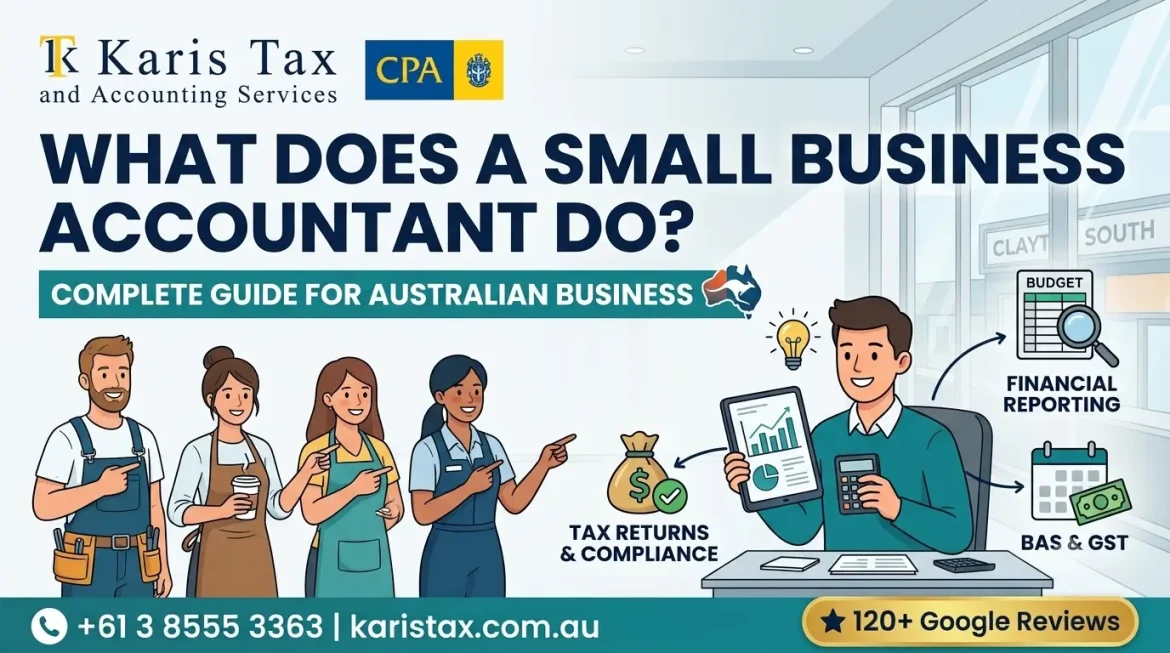
What Does a Small Business Accountant Do? Complete Guide for Australian Businesses
A small business accountant helps business owners manage financial records, tax obligations, reporting and accounting requirements. Depending on the business structure and circumstances, an accountant may assist with business tax returns, bookkeeping, BAS, GST, payroll, financial reporting, tax planning and ATO compliance.
The services an accountant can provide depend on their qualifications, registration and the specific requirements of the business.
For example, tax agent services provided for a fee generally require registration with the Tax Practitioners Board (TPB) unless an exemption applies. BAS services provided for a fee or other reward also generally require appropriate TPB registration.
At Karis Tax, we provide small business accounting and tax support for businesses in Clayton South and surrounding Melbourne areas.
What Does a Small Business Accountant Actually Do?
The role of a small business accountant can vary depending on the size, structure and needs of the business.
Common accounting services may include:
- Business tax return preparation and lodgement
- Bookkeeping and financial record management
- BAS preparation and lodgement
- GST reporting and support
- Payroll support
- Financial reporting
- Tax planning
- Business structure considerations
- ATO compliance support
- Business expense and deduction guidance
Where a service is a regulated tax or BAS service, it should be provided by an appropriately registered tax agent or BAS agent, where required. A business may use an accountant for one specific service, such as an annual tax return, or for ongoing accounting and financial support.
1. Business Tax Returns
One of the main services a small business accountant may provide is assistance with income tax obligations.
Tax return requirements differ depending on the business structure. Sole traders generally report their business income and relevant business information through their individual income tax return rather than lodging a separate business tax return. Companies, trusts and other structures can have different reporting requirements.
An appropriately registered tax agent can assist with:
- Reviewing business income
- Reviewing business expenses
- Identifying relevant deductions
- Preparing financial information
- Preparing the tax return
- Reviewing the completed return
- Lodging the return with the ATO
- Providing tax-related advice
Karis Tax and Accounting page states that it provides tax return preparation and lodgement and taxation consulting and advice as a registered tax agent.
2. Bookkeeping and Financial Records
Bookkeeping involves recording and organising the financial transactions of a business.
This can include:
- Recording sales
- Recording business expenses
- Bank reconciliation
- Managing invoices
- Tracking payments
- Maintaining financial records
- Preparing financial information for tax and BAS reporting
Good record keeping can help business owners understand their financial position, manage cash flow and meet applicable tax and reporting obligations.
Karis Tax provides bookkeeping services for small and medium businesses, including bookkeeping support, GST-related work and BAS preparation and lodgement.
3. BAS Preparation and Lodgement
A Business Activity Statement (BAS) is used by businesses to report and pay certain tax obligations, including GST and some PAYG obligations.
BAS services can include activities such as:
- BAS preparation
- BAS review
- GST reporting
- PAYG reporting
- Reconciling financial records
- BAS lodgement
- Assistance with overdue BAS matters
However, BAS services are regulated. An entity providing BAS services for a fee or other reward generally needs to be registered with the Tax Practitioners Board, unless an applicable exemption applies.
The TPB explains that BAS services can involve advising on or determining a client’s liabilities, obligations or entitlements under BAS provisions, including GST and PAYG matters.
4. GST Management
GST can be an important consideration for many Australian businesses.
Depending on the business’s circumstances, accounting support may include:
- GST registration guidance
- GST record keeping
- GST reconciliation
- GST reporting
- BAS preparation
- GST compliance support
Not every business has the same GST obligations. The appropriate treatment depends on the business’s circumstances and current ATO requirements.
Where GST advice or BAS services constitute regulated services, they should be provided by an appropriately registered tax agent or BAS agent, where required. The TPB identifies GST-related services as part of the BAS framework in relevant circumstances.
5. Payroll and Employee Accounting
If a small business employs staff, payroll becomes an important part of financial administration.
Depending on their qualifications, role and registration, an accountant or payroll professional may assist with areas such as:
- Payroll processing
- PAYG withholding administration
- Employee records
- Payslips
- Superannuation-related records
- Payroll reporting
- Single Touch Payroll (STP)
However, not every accountant or payroll professional is authorised or qualified to provide every payroll, tax or BAS-related service.
Where payroll work involves regulated tax or BAS services, the service should be provided by an appropriately registered tax agent or BAS agent, where required.
Karis Tax currently offers payroll services as part of its bookkeeping services.
6. Financial Reporting
A small business accountant can help business owners understand how their business is performing through financial reports.
Depending on the business, reports may include:
Profit and Loss Statement
Shows business income, expenses and the resulting profit or loss for a particular period.
Balance Sheet
Provides information about the business’s assets, liabilities and equity.
Cash Flow Information
Helps business owners understand money coming into and going out of the business.
Financial reports can help business owners make informed decisions about expenses, growth and cash flow.
7. Tax Planning
Tax planning involves considering a business’s tax position and obligations based on its circumstances and applicable Australian tax rules.
An appropriately qualified and registered tax professional may assist with areas such as:
- Tax planning
- Business deductions
- Taxable income
- PAYG instalments
- GST considerations
- Capital Gains Tax considerations
- Year-end tax preparation
The objective is not simply to reduce tax at any cost. Appropriate tax planning should consider the applicable Australian tax rules and the specific circumstances of the business.
8. Business Structure
The structure of a business can affect its tax and reporting obligations.
Common business structures include:
- Sole trader
- Partnership
- Company
- Trust
The tax treatment and reporting requirements can differ between structures.
An accountant can help business owners understand the accounting and tax considerations associated with their business structure. Where a matter involves legal advice or complex legal structuring, specialist legal advice may also be appropriate.
For example, a sole trader generally reports business income and relevant business information through their individual tax return.
9. ATO Compliance
Australian businesses can have different tax and reporting obligations depending on their structure, registrations and activities.
These may include:
- Income tax
- GST
- BAS
- PAYG
- Payroll-related obligations
- Record keeping
- Other applicable tax reporting
An appropriately qualified and registered tax professional can help businesses understand applicable obligations, prepare relevant information and meet reporting requirements.
If you have outstanding tax or BAS obligations, professional assistance can also help you understand the appropriate next steps.
What Is the Tax Practitioners Board?
The Tax Practitioners Board (TPB) regulates registered tax and BAS practitioners in Australia.
People or entities providing tax agent services or BAS services for a fee or other reward generally need to be registered with the TPB unless an applicable exemption applies.
The TPB maintains a public register where consumers can check whether a tax or BAS practitioner is registered.
Important: Registration requirements depend on the nature of the service and the circumstances. Businesses should check the current TPB requirements where necessary.
Do I Need a Small Business Accountant?
You are not necessarily required to hire an accountant for every aspect of running a business.
However, professional accounting support can be useful when:
- You’re starting a new business
- Your business is growing
- Your bookkeeping is becoming difficult to manage
- You need help with BAS or GST
- You’re hiring employees
- Your tax affairs are becoming more complex
- You have overdue tax obligations
- You need financial reports
- You’re considering changing your business structure
- You want professional tax planning advice
The type of professional you need depends on the services required and their qualifications or registration.
How Can a Small Business Accountant Help a New Business?
A new business may need to establish systems for:
- Business banking
- Bookkeeping
- Record keeping
- Tax registrations
- GST
- BAS
- Payroll
- Financial reporting
- Tax planning
Setting up these processes correctly from the beginning can make financial management easier as the business grows. Where tax or BAS services are involved, make sure the practitioner is appropriately registered where required.
When Should I Hire a Small Business Accountant?
There isn’t one specific point when every business should hire an accountant.
You may want professional accounting support when your business:
Starts → grows → hires employees → registers for GST → has more complex tax obligations → needs financial reporting → requires ongoing tax planning.
You can also engage an accountant earlier if you want professional guidance when establishing your financial systems.
How Much Does a Small Business Accountant Cost?
There is no single price for small business accounting services.
The cost can depend on:
- Business size
- Number of transactions
- Services required
- Bookkeeping workload
- Payroll requirements
- BAS frequency
- Tax complexity
- Whether you need one-off or ongoing support
For this reason, accounting firms may provide different pricing depending on the services required.
Small Business Accountant in Clayton South & Melbourne
Karis Tax provides small business accounting services in Clayton South and surrounding Melbourne suburbs.
Services may include:
- Business tax returns
- Bookkeeping
- BAS
- GST
- Payroll
- Financial reporting
- Tax planning
- ATO compliance
Whether you’re a new business owner or an established small business, the appropriate accounting and tax support can help you manage your financial and compliance requirements.
Karis Tax’s existing small business service page covers bookkeeping, BAS/GST/IAS, payroll, financial reporting, business and personal tax returns, tax advice and business structure considerations.
Frequently Asked Questions
What does a small business accountant do?
A small business accountant may assist with business tax returns, bookkeeping, BAS, GST, payroll, financial reporting, tax planning and compliance requirements, depending on their qualifications, registration and the services they provide.
Do I need a small business accountant?
Not every business needs ongoing accounting services. Professional support can be useful when dealing with tax, BAS, bookkeeping, payroll, financial reporting or more complex business requirements.
What is the difference between an accountant and a bookkeeper?
A bookkeeper generally focuses on recording and organising day-to-day financial transactions. An accountant may provide broader services such as financial analysis, tax preparation, financial reporting and tax-related advice, subject to their qualifications and registration.
Can a small business accountant help with BAS?
Yes, where the practitioner is appropriately registered to provide the relevant BAS service. BAS services provided for a fee or other reward generally require TPB registration unless an exemption applies.
Can an accountant help with tax planning?
Yes. An appropriately qualified and registered tax professional can provide tax-related planning and advice based on the business’s circumstances and applicable Australian tax rules.
When should I hire an accountant?
You may consider hiring an accountant when starting or growing a business, hiring employees, dealing with GST or BAS, managing complex tax obligations, needing financial reporting or requiring ongoing tax planning.
Does a sole trader lodge a separate business tax return?
Generally, no. A sole trader reports business income and relevant business information through their individual income tax return. The requirements can differ depending on the taxpayer’s circumstances.
Conclusion
A small business accountant can do much more than prepare an annual tax return. Depending on the business and the professional’s qualifications and registration, accounting support may include tax returns, bookkeeping, BAS, GST, payroll, financial reporting, tax planning and compliance.
For small business owners, organised financial records and a clear understanding of tax obligations can make it easier to manage finances and make informed business decisions.
If you need professional accounting support, Karis Tax provides small business accounting services in Clayton South and Melbourne.